
MATLAB Phased Array System Toolbox: Radar and Sonar Signal Processing Simulation for Defense Engineers
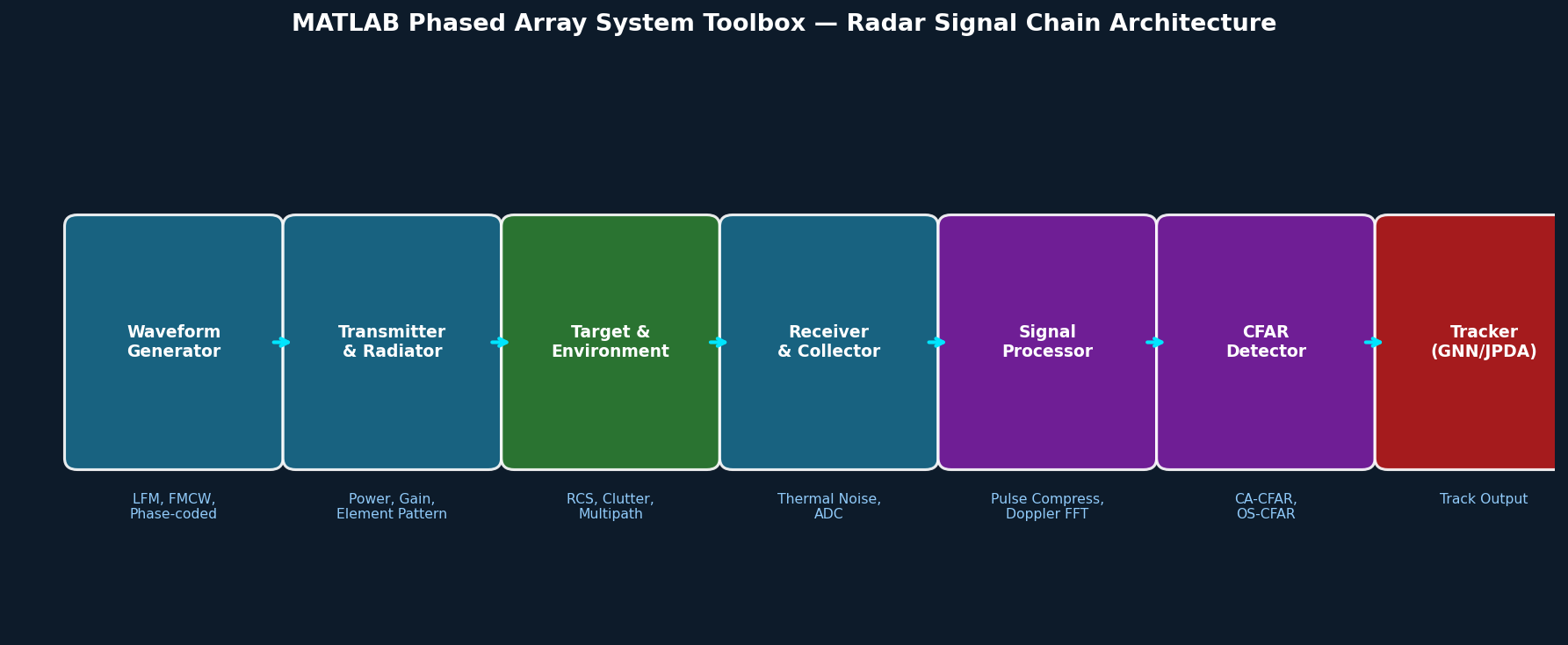
The MATLAB Phased Array System Toolbox is one of the most comprehensive commercial platforms available for modeling radar, sonar, and electronic warfare (EW) signal chains. Unlike the Aerospace Blockset—which focuses on flight dynamics and 6-DOF equations of motion—the Phased Array System Toolbox targets the RF and acoustic signal processing layer: waveform generation, beamforming, target detection, and tracking. For defense engineers working on radar system design, electronic countermeasures, or sonar array processing, it provides a tightly integrated simulation environment that spans from antenna element physics to CFAR detector performance.
Architecture: From Waveform to Track
The toolbox is organized around a signal-chain paradigm. A typical simulation pipeline consists of:
- Waveform Generator – Produces LFM chirps, stepped-frequency, FMCW, or custom coded waveforms.
- Transmitter / Radiator – Models transmit power, gain, and element-level radiation patterns.
- Target / Environment – Computes RCS (Radar Cross Section) returns, clutter, and multipath using built-in Swerling models and surface clutter generators.
- Collector / Receiver – Applies thermal noise (via
phased.ReceiverPreamp) and ADC quantization. - Signal Processor – Implements pulse compression, Doppler FFT, CFAR detection, and angle-of-arrival estimation.
- Tracker – Feeds detections into GNN (Global Nearest Neighbor) or JPDA (Joint Probabilistic Data Association) trackers.
Each stage is implemented as a MATLAB System object, enabling both script-based batch analysis and Simulink block-diagram integration for hardware-in-the-loop (HIL) workflows.

Beamforming: Conventional, MVDR, and LCMV
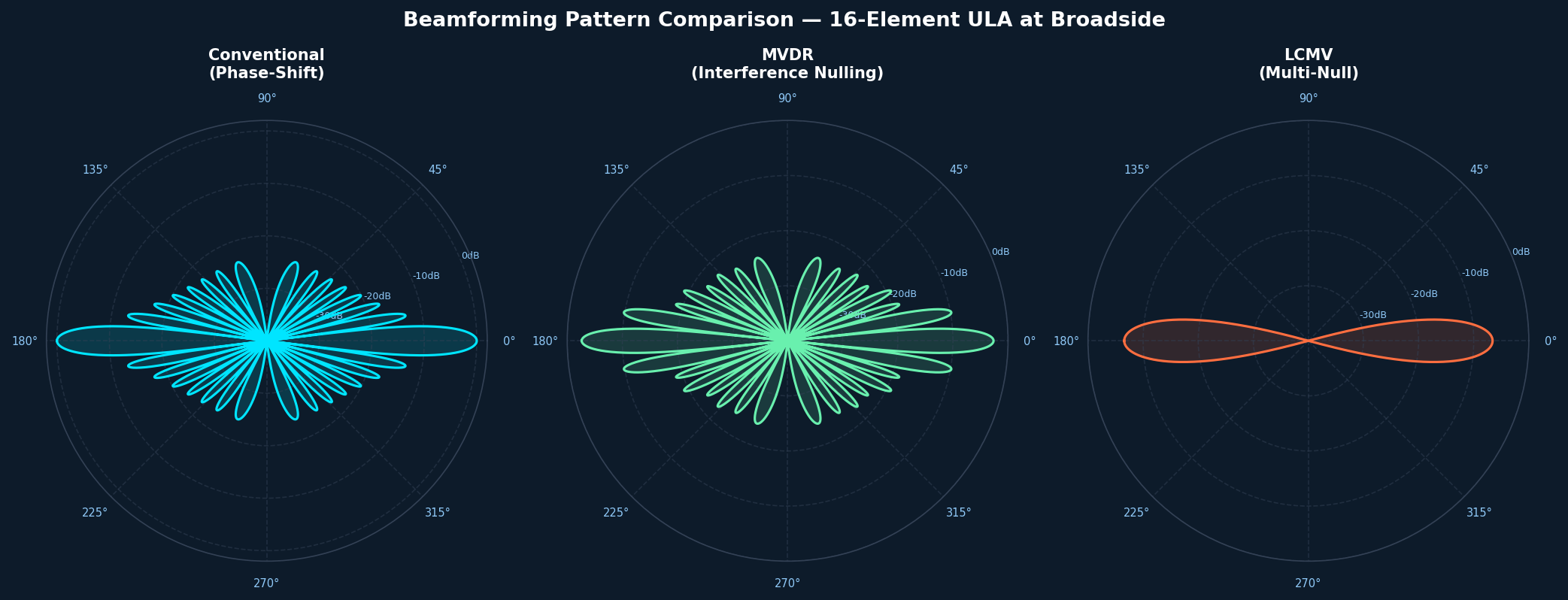
Beamforming is central to phased array radar performance. The toolbox provides three primary algorithms accessible through a unified interface:
- Conventional (Phase-Shift) Beamformer (
phased.PhaseShiftBeamformer): Steers the main lobe by applying progressive phase shifts across elements. Computationally cheap; suitable for real-time embedded prototyping. - MVDR (Minimum Variance Distortionless Response) (
phased.MVDRBeamformer): Minimizes output power subject to a distortionless constraint in the look direction. Provides superior interference nulling—critical for jamming-dense environments. - LCMV (Linearly Constrained Minimum Variance) (
phased.LCMVBeamformer): Extends MVDR with multiple linear constraints, enabling simultaneous null placement against multiple jammers while maintaining gain toward multiple targets of interest.
A practical workflow for EW analysis involves sweeping jammer-to-signal ratio (JSR) across a range of angles and comparing SINR curves for each beamformer. The toolbox's phased.ULA (Uniform Linear Array) and phased.URA (Uniform Rectangular Array) objects make it straightforward to parameterize element spacing, mutual coupling, and element pattern effects.
CFAR Detection and ROC Analysis
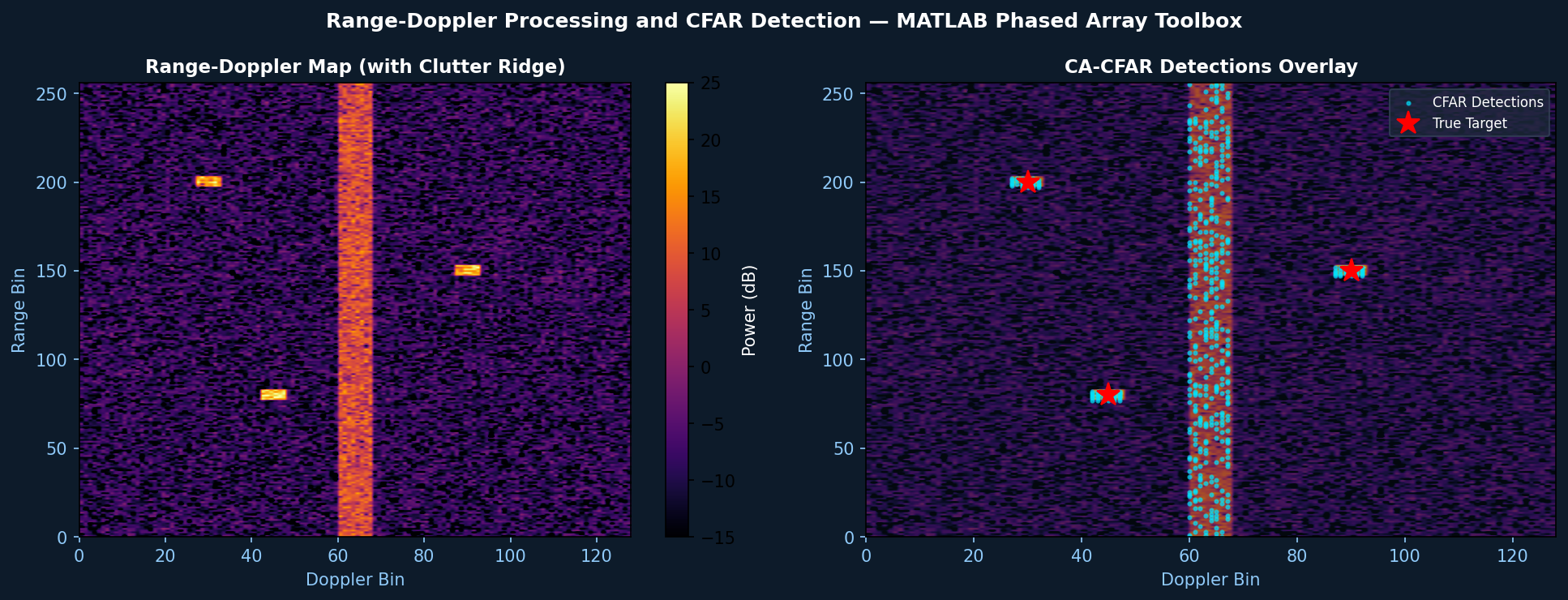
Constant False Alarm Rate (CFAR) detection is the standard approach for maintaining a controlled false alarm rate in non-stationary clutter. The toolbox implements:
- CA-CFAR (
phased.CFARDetector): Cell-Averaging CFAR; robust in homogeneous clutter. - OS-CFAR (
phased.CFARDetectorwith'Method','OS'): Ordered-Statistics CFAR; handles clutter edges and multiple targets in the reference window. - 2D CFAR (
phased.CFARDetector2D): Operates on range-Doppler maps for simultaneous range and velocity discrimination.
The rocpfa and rocsnr functions generate Receiver Operating Characteristic curves analytically, while Monte Carlo simulation with the System objects provides empirical ROC data under realistic clutter and jamming conditions. Defense programs routinely use this workflow to establish Pd/Pfa requirements early in the system design phase.
Space-Time Adaptive Processing (STAP)
For airborne radar facing ground clutter, Space-Time Adaptive Processing is essential. The toolbox includes phased.STAPSMIBeamformer (Sample Matrix Inversion) and supports custom STAP implementations via the phased.AngleDopplerResponse object for visualizing the clutter ridge in the angle-Doppler plane.
A typical STAP workflow:
- Generate a clutter covariance matrix using
phased.ConstantGammaClutterwith terrain-specific gamma values. - Estimate the adaptive weights using SMI or diagonal loading.
- Apply weights to the space-time snapshot and evaluate improvement factor (IF) versus Doppler frequency.
This workflow is directly applicable to GMTI (Ground Moving Target Indication) radar design, a core capability in ISR platforms.
Waveform Design and LPI Radar
Low Probability of Intercept (LPI) radar design requires careful waveform selection to minimize detectability by ESM (Electronic Support Measures) receivers. The toolbox supports:
- FMCW waveforms (
phased.FMCWWaveform): Continuous-wave chirp with low peak power; widely used in short-range surveillance and automotive radar. - Phase-coded waveforms (
phased.PhaseCodedWaveform): Barker, Frank, and P4 codes with high time-bandwidth products for range resolution without high peak power. - Stepped-frequency (
phased.SteppedFMWaveform): Synthesizes high-range resolution profiles from narrowband pulses.
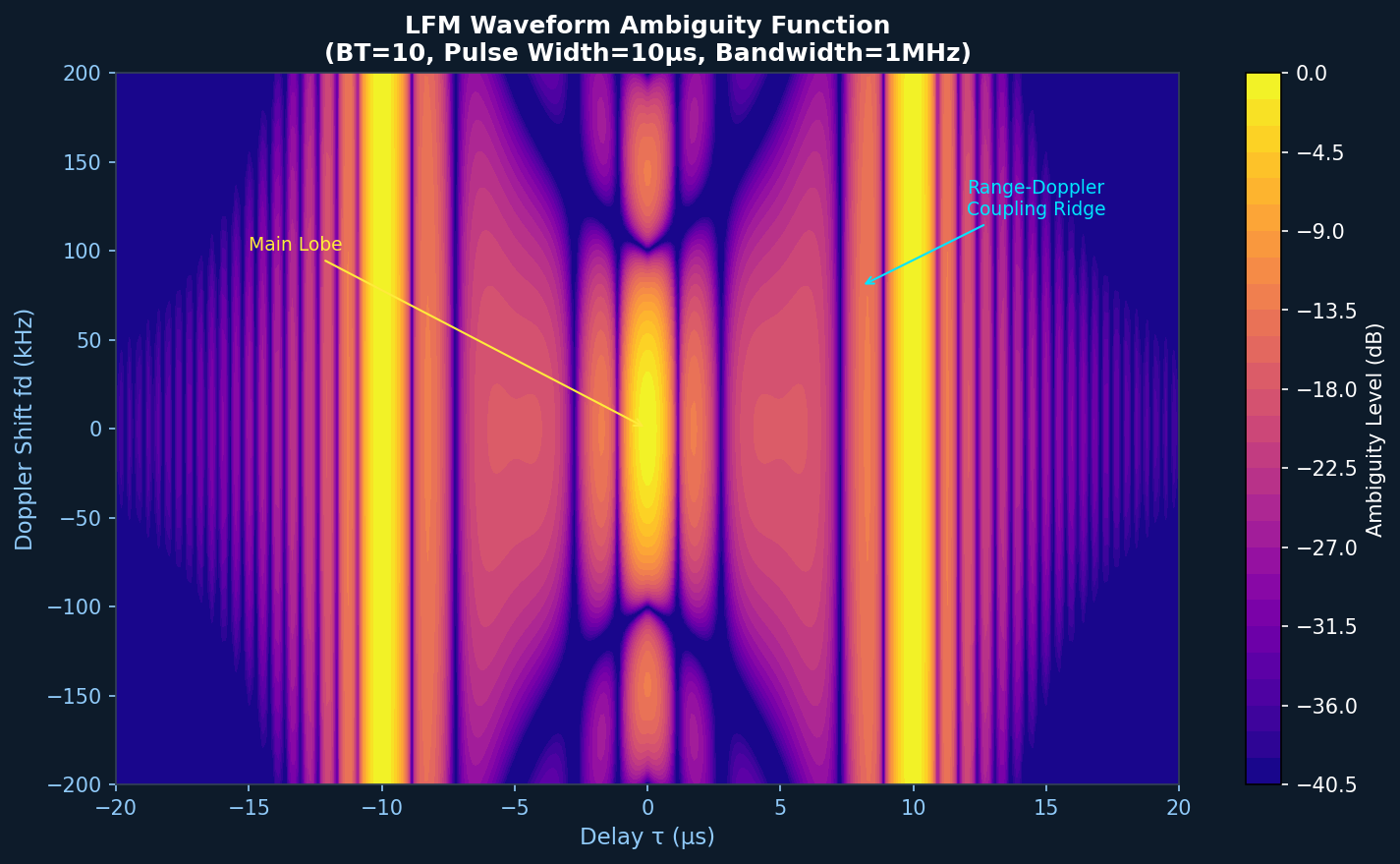
Ambiguity function analysis (ambgfun) is the standard tool for evaluating range-Doppler coupling and sidelobe structure, directly informing waveform selection trade studies.
Integration with Simulink and Hardware-in-the-Loop
For programs requiring DO-178C or MIL-STD-882 compliance, the toolbox integrates with Simulink via Phased Array System Toolbox blocks. Signal processing chains can be auto-coded to C/C++ using MATLAB Coder and Embedded Coder, enabling deployment to FPGA or DSP targets. Combined with the RF Blockset for front-end hardware modeling, this creates a complete virtual prototype from antenna to track output—reducing the number of costly hardware integration tests.
Practical Recommendations
- Validate element patterns early: Use measured element patterns (imported as custom
phased.CustomAntennaElementobjects) rather than isotropic assumptions to avoid optimistic beamforming predictions. - Use heterogeneous arrays for conformal designs:
phased.HeterogeneousULAsupports mixed element types, essential for conformal fuselage arrays. - Leverage GPU acceleration: Large Monte Carlo CFAR and STAP runs benefit significantly from
gpuArrayinputs, reducing overnight batch times by 5–10×. - Export to STK: Range-Doppler maps and track outputs can be exported and visualized in AGI STK for mission-level analysis, bridging the signal-processing and mission-planning domains.
Further Resources
- MathWorks Phased Array System Toolbox Documentation
- Radar System Design with MATLAB (MathWorks Training)
- Richards, Scheer & Holm – Principles of Modern Radar (SciTech Publishing)
- IEEE Aerospace and Electronic Systems Society
The MATLAB Phased Array System Toolbox occupies a unique position in the defense simulation ecosystem: it bridges the gap between theoretical radar signal processing and executable, hardware-deployable implementations. For engineers designing next-generation radar, EW, or sonar systems, it remains the most complete commercial simulation environment available.