

Missile DATCOM: Aerodynamic Coefficient Prediction for Guided Munitions and Tactical Missiles
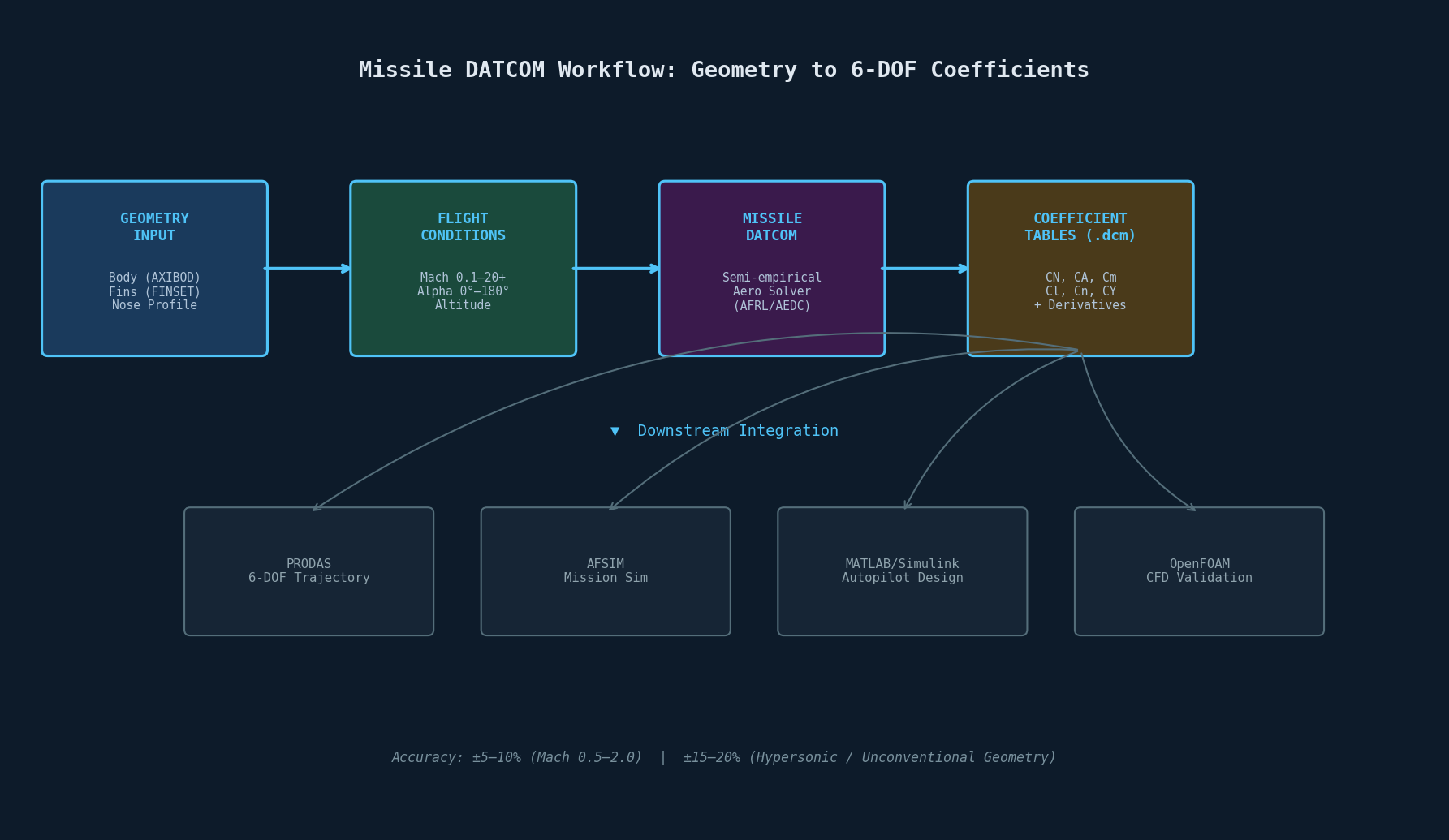
Missile DATCOM (Data Compendium) is a semi-empirical aerodynamic prediction tool developed by the U.S. Air Force Research Laboratory (AFRL) and maintained by the Air Force's Arnold Engineering Development Complex (AEDC). It provides rapid, physics-grounded estimates of aerodynamic stability and control derivatives for missiles, rockets, and finned projectiles across a wide range of Mach numbers and angles of attack — without requiring a full CFD campaign. For defense engineers working in early-stage missile design, trajectory analysis, or flight control law development, Missile DATCOM is an indispensable first-pass tool.
What Missile DATCOM Does
At its core, Missile DATCOM solves the aerodynamic coefficient problem: given a missile geometry (body, fins, nose, boattail) and flight conditions (Mach number, angle of attack, altitude), it returns the full set of force and moment coefficients — C_N, C_A, C_m, C_l, C_n, C_Y — along with their derivatives with respect to angle of attack, sideslip, and control deflection. These coefficients feed directly into 6-DOF trajectory simulations, autopilot design tools, and hardware-in-the-loop (HIL) test benches.
The tool covers:

- Mach range: 0.1 to 20+ (subsonic through hypersonic)
- Angle of attack: 0° to 180° (including high-alpha and tumbling regimes)
- Configuration types: axisymmetric bodies, cruciform and planar fin arrangements, canard-tail combinations, wrap-around fins, and multi-stage configurations
Input File Structure
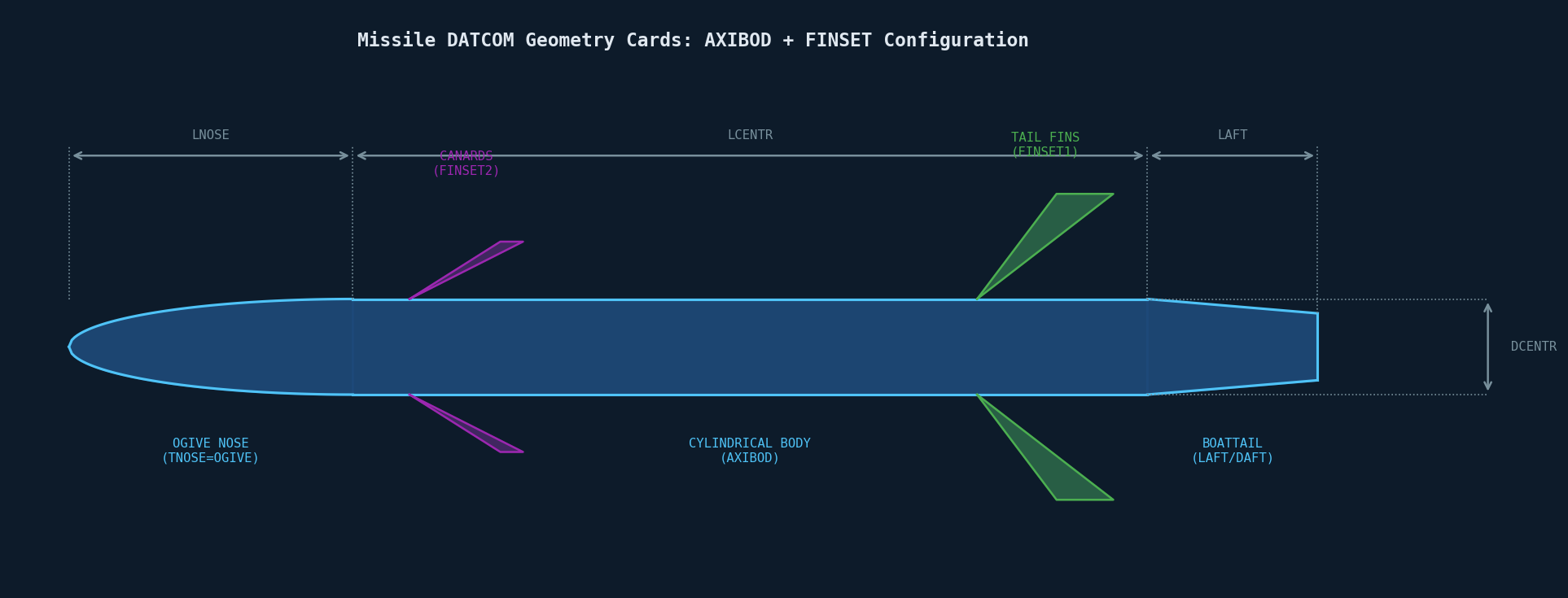
Missile DATCOM uses a NAMELIST-based input format (Fortran-style). A minimal input deck specifies:
 $FLTCON NMACH=5., MACH(1)=0.5,0.8,1.2,2.0,3.0,
         NALPHA=7., ALPHA(1)=-4.,-2.,0.,2.,4.,8.,12., $END
 $REFQ XCG=1.524, SREF=0.01824, LREF=0.1524, LATREF=0.1524, $END
 $AXIBOD TNOSE=OGIVE, LNOSE=0.381, DNOSE=0.1524,
         LCENTR=2.286, DCENTR=0.1524,
         LAFT=0.254, DAFT=0.1016, $END
 $FINSET1 SSPAN(1)=0.1524,0.3048, CHORD(1)=0.2032,0.1016,
          SECTYP=HEX, ZUPPER(1)=0.005,0.005, $END
 CASEID Example Missile Configuration
 DAMP
 SAVE
 NEXT CASE
The DAMP card activates pitch and roll damping derivative calculations. The SAVE card writes binary output for post-processing. Each NEXT CASE card advances to the next flight condition block.
Workflow: From Geometry to 6-DOF Coefficients
A typical Missile DATCOM workflow for a new guided munition program follows these stages:
1. Geometry Parameterization
Engineers define the missile body using DATCOM's axisymmetric body cards (AXIBOD) or general body cards (GENBOD for non-circular cross-sections). Fin geometry is specified via FINSET cards, supporting up to four independent fin sets. Nose shapes include ogive, cone, power-series, and Haack series profiles.
2. Coefficient Table Generation
Running DATCOM produces a structured output file (.out) and optionally a binary coefficient table (.dcm). The .dcm file is the primary deliverable — it contains multi-dimensional lookup tables indexed by Mach number, angle of attack, and control deflection angle.
3. Integration with 6-DOF Simulators
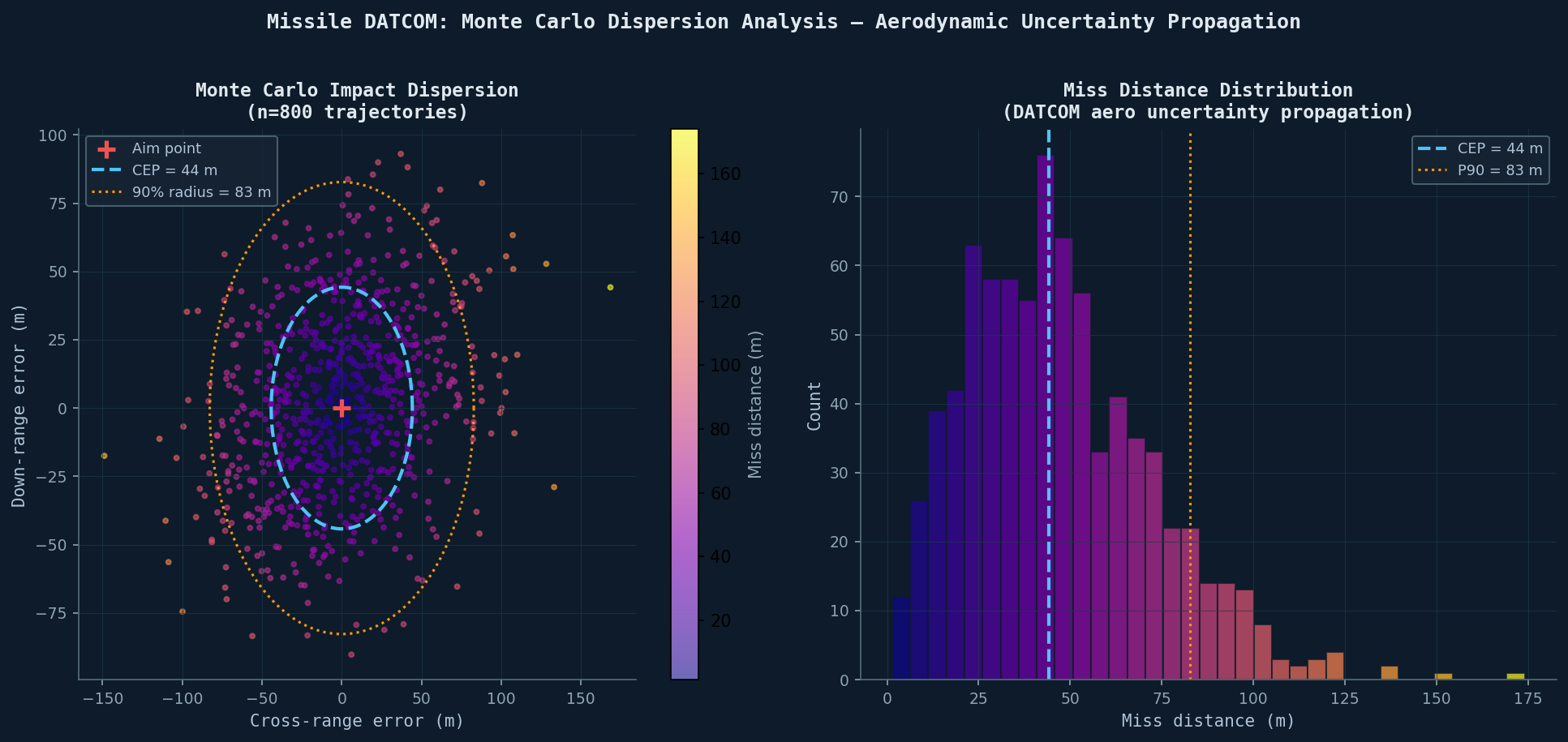
The .dcm binary tables are read directly by trajectory simulation tools such as PRODAS (Arrow Tech), MATLAB/Simulink (via custom S-functions), and AFSIM. The coefficient tables are interpolated at each integration time step to compute aerodynamic forces and moments. This approach is far faster than real-time CFD and is standard practice for Monte Carlo dispersion analyses requiring thousands of trajectory runs.
4. Validation Against Wind Tunnel Data
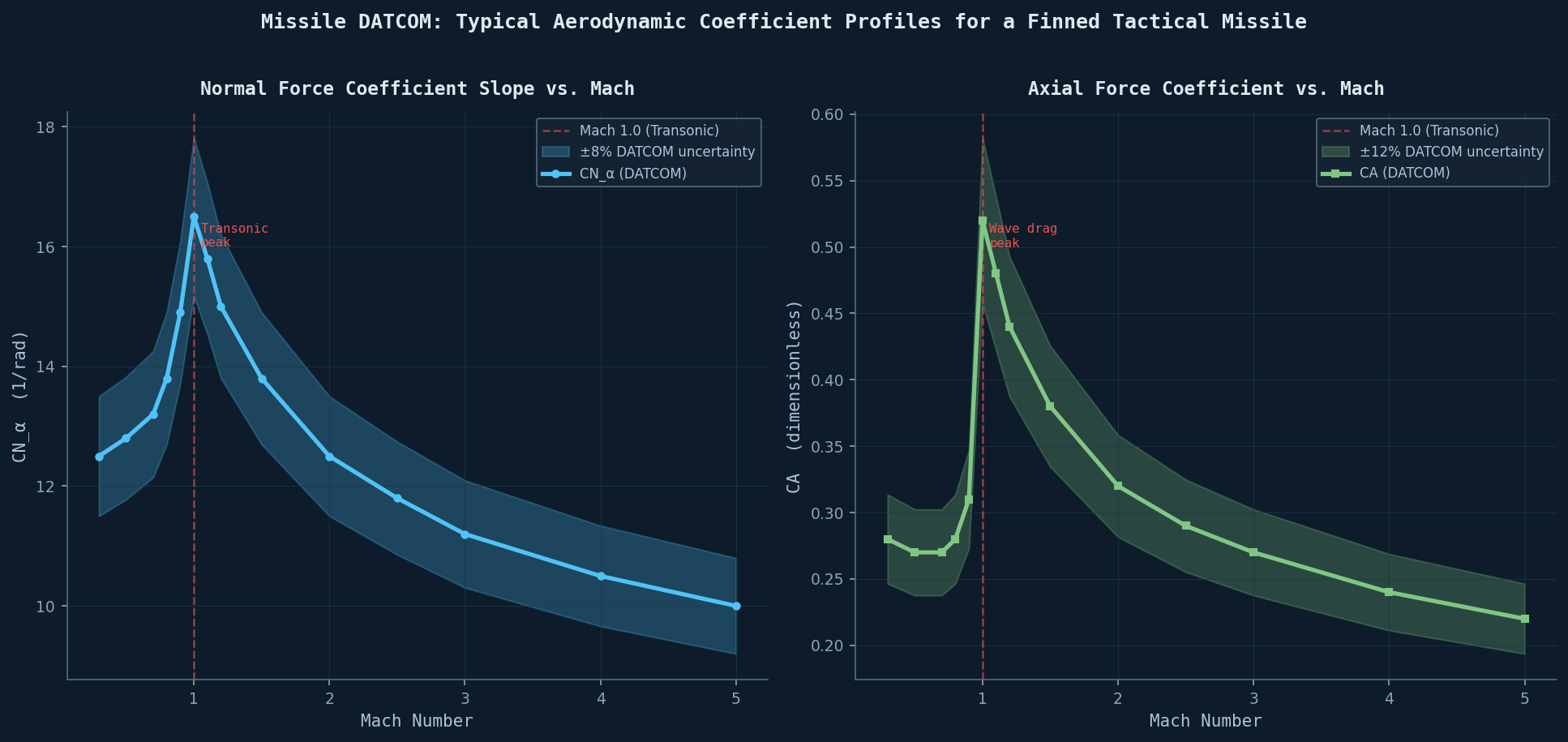
Missile DATCOM predictions are semi-empirical and carry known accuracy bounds. For subsonic and low supersonic regimes (Mach 0.5–2.0), normal force coefficient errors are typically within ±5–10% for conventional configurations. At hypersonic speeds or for unconventional geometries (wrap-around fins, non-circular bodies), errors can exceed 15–20%, and CFD validation is recommended. AFRL publishes validation datasets for standard configurations (e.g., the Basic Finner, Army-Navy Spinner) that engineers should use to calibrate confidence intervals before operational use.
Best Practices for Defense Applications
Use DATCOM for design space exploration, not final certification. The tool's speed (seconds per case vs. hours for CFD) makes it ideal for parametric sweeps — varying fin span, nose length, or boattail angle across hundreds of configurations to identify the Pareto front of drag vs. stability margin.
Always run the DAMP card. Pitch damping derivatives (C_mq + C_m_alpha_dot) are critical for autopilot design and are frequently omitted in quick analyses. Neglecting them leads to overly optimistic stability margins in the flight control model.
Cross-check with PRODAS or AEROLAB for spin-stabilized projectiles. Missile DATCOM's Magnus effect modeling (C_lp, C_np) is less mature than its fin-stabilized aerodynamics. For artillery shells and spin-stabilized rockets, dedicated tools like PRODAS provide better accuracy.
Automate batch runs with Python wrappers. The DATCOM input format is text-based and easily templated. A Python script using string.Template or Jinja2 can generate hundreds of input decks for Monte Carlo geometry uncertainty analysis, run them in parallel, and parse the output tables into a unified HDF5 database for downstream trajectory simulation.
Accessing Missile DATCOM
Missile DATCOM is export-controlled under EAR/ITAR and is distributed through the Defense Technical Information Center (DTIC) to qualified U.S. government contractors and research institutions. The current version (97) is available via:
- DTIC: https://discover.dtic.mil (requires DoD affiliation or contractor registration)
- AFRL/RQ: Direct requests through the Munitions Directorate for government programs
- Commercial wrappers: Tools like Missile Flight Simulation (MFS) and PRODAS bundle DATCOM-compatible aerodynamic databases with GUI front-ends for non-ITAR environments
Complementary Tools
| Tool | Role | Relationship to DATCOM |
|---|---|---|
| PRODAS | 6-DOF trajectory + aero | Reads DATCOM-format tables |
| AFSIM | Mission-level simulation | Ingests DATCOM coefficient tables via plugin |
| OpenFOAM / OVERFLOW | High-fidelity CFD | Validates DATCOM predictions at critical Mach points |
| JSBSim | Flight dynamics engine | Can consume DATCOM-derived aero tables via XML |
| STK | Orbital/trajectory analysis | Uses DATCOM outputs for reentry vehicle aero |
Conclusion
Missile DATCOM remains the workhorse aerodynamic prediction tool for early-stage missile and munitions design in the U.S. defense community. Its combination of speed, broad Mach coverage, and direct integration with 6-DOF simulation environments makes it uniquely valuable for design trade studies and autopilot development. Engineers should treat its outputs as high-quality engineering estimates — accurate enough to drive design decisions, but requiring CFD validation at critical flight conditions before hardware commitment.
For further reading: