
OpenFOAM v2512: GAMG Reproducibility, AMI Caching Speedups, and a New Immersed Boundary Method
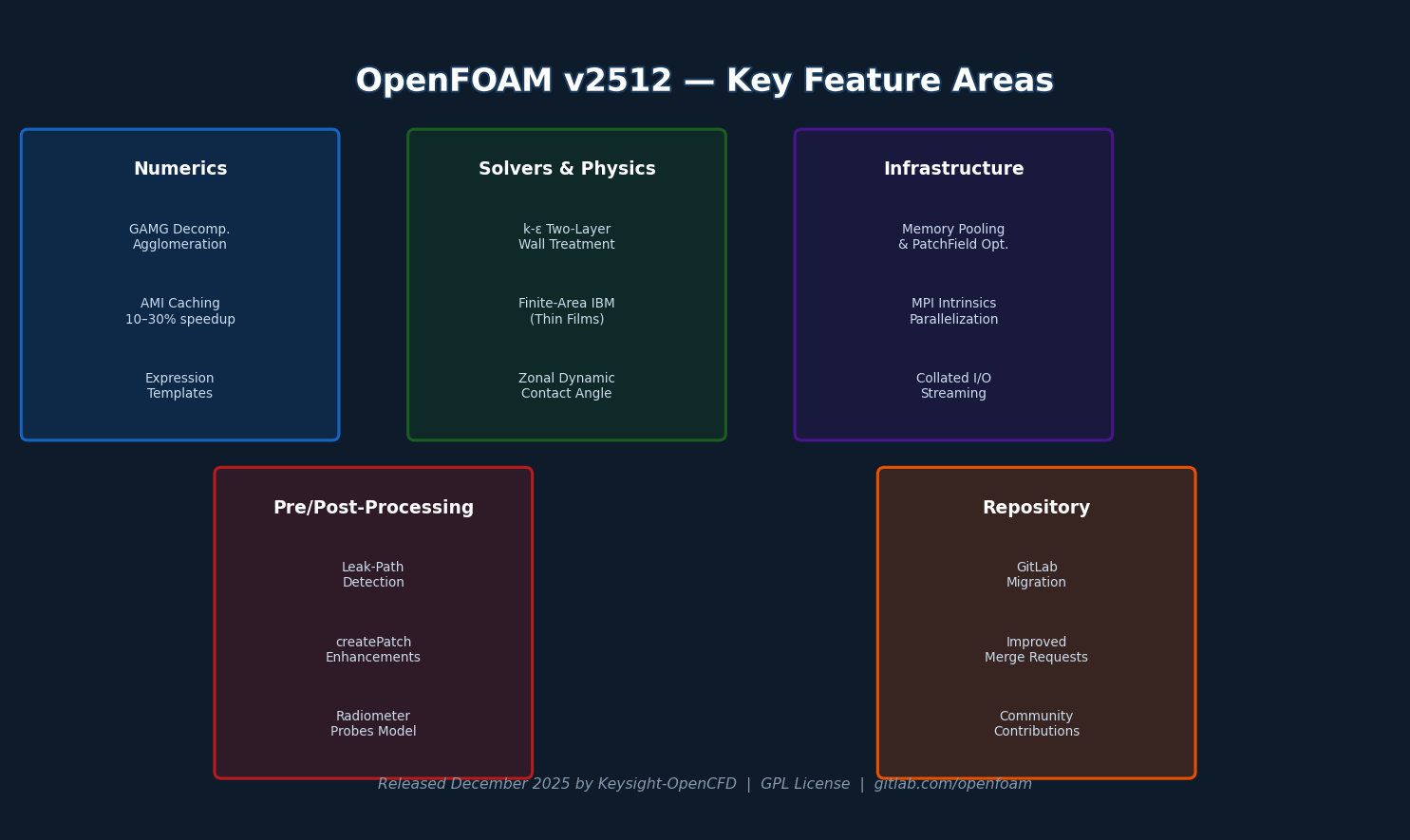
OpenFOAM, the world's most widely used open-source CFD platform, received a significant update in December 2025 with the release of v2512. Developed and maintained by the Keysight-OpenCFD team, this release delivers targeted improvements across numerical solvers, turbulence modeling, parallel computing infrastructure, and the project's development workflow. Here is a technical breakdown of what engineers and researchers can expect.
Numerical Solver Enhancements
GAMG: Decomposition Agglomeration and Reproducibility
The Geometric-Algebraic Multi-Grid (GAMG) solver—a cornerstone of OpenFOAM's pressure and velocity solution—gains two important updates:
- Decomposition Agglomeration: A new
decompositionagglomeration strategy allows users to leverage existing domain-decomposition algorithms (e.g.,scotch) for multigrid coarsening. This gives practitioners finer control over coarsening levels and can improve convergence on complex, unstructured meshes. - Reproducible Results: A community-contributed fix (led by AMD) resolves non-deterministic behavior in
pairGAMGAgglomerationthat previously caused run-to-run variation in convergence paths when OpenMP-style offloading was active. Simulations will now produce consistent results across repeated runs—a critical requirement for validation and regression testing.
AMI Caching: 10–30% Speedup in Moving-Mesh Cases
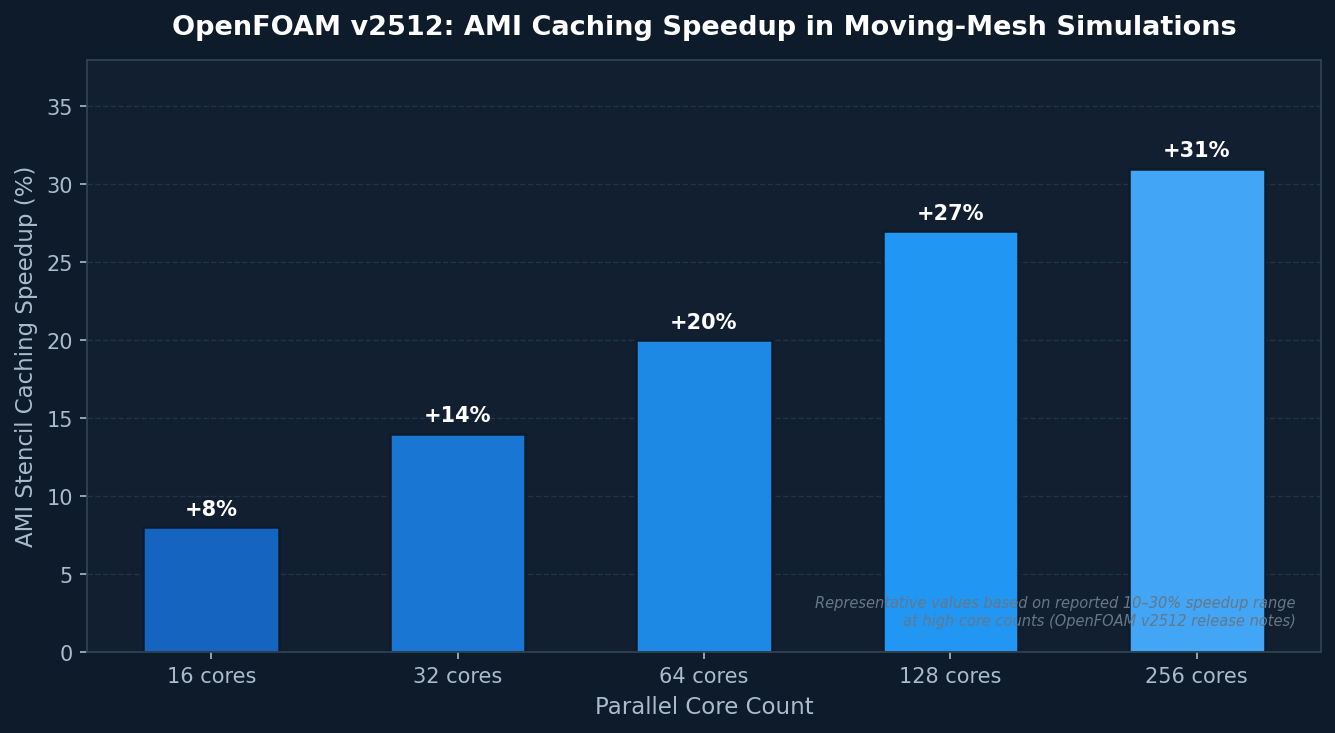
Arbitrary Mesh Interface (AMI) stencils and interpolation weights can now be cached between time steps, eliminating redundant parallel communication and stencil reassembly. Benchmarks reported in the release notes show 10–30% wall-clock speedups in moving-mesh simulations at high core counts—a meaningful gain for rotating machinery, sliding interfaces, and overset mesh workflows.

Expression Templates and Gradient Caching
An initial expression-template library fuses multiple field operations into single computational kernels, reducing intermediate memory allocations and laying the groundwork for future GPU offloading. Complementing this, in-place gradient updates eliminate repeated memory allocations in gradient-intensive solvers, providing measurable performance gains on large meshes.
Turbulence Modeling: k-ε Two-Layer Wall Treatment
A new twoLayerTreatment flag has been added to the standard k-epsilon model. When enabled, the solver applies algebraic relations for turbulent viscosity (νt) and dissipation (ε) in the inner wall layer (y⁺ < 11), reverting to the standard k-ε formulation in the outer layer. This approach significantly reduces grid sensitivity near walls, improving predictions of wall shear stress and heat flux on resolved boundary-layer meshes—without requiring a full low-Reynolds-number model.
New Physics: Finite-Area Immersed Boundary Method
OpenFOAM v2512 introduces an Immersed Boundary Method (IBM) for the finite-area (FA) library, enabling thin-film simulations over complex, non-conforming geometries. Activated via the kinematicThinFilmIBM boundary condition, the method reads obstacle geometry from standard surface files (e.g., .obj) and supports body motion through solidBodyMotionFunction. A dedicated tutorial ($FOAM_TUTORIALS/lagrangian/kinematicParcelFoam/windshield) demonstrates the feature for automotive surface-film applications.
Infrastructure and Parallelization
- Memory Pooling: New
PatchFieldfunctions reduce memory allocation overhead in field operations, lowering peak memory usage on large parallel jobs. - Collated I/O: Collated-IO stream processing improves file I/O throughput for high-core-count runs writing large result sets.
- MPI Intrinsics: Integration of MPI intrinsics enables more efficient collective communication patterns on modern HPC clusters.
Repository Migration to GitLab
A significant administrative milestone accompanies this release: all core OpenFOAM repositories have been fully migrated to GitLab. The move brings improved merge-request workflows, better code-review tooling, and a more accessible contribution pipeline for the global community. Existing contributors will need to update their remote URLs and create a GitLab account to submit patches.
Availability
OpenFOAM v2512 is distributed under the GPL license. Pre-compiled packages are available for Ubuntu 24.04/22.04 LTS, openSUSE Leap, and Red Hat/Fedora variants. Apptainer and Docker container images are also provided for HPC and cloud deployments. Full release notes and download links are available at openfoam.com.