

Simcenter 3D 2606: Attribute-Driven FEM, E-Motor NVH Synthesis, and Smarter Nastran Workflows
Siemens released Simcenter 3D 2606 in July 2026 as part of its biannual simulation portfolio update, delivering targeted advances across structural, acoustic, multibody, and electromagnetic workflows. The release reflects the ongoing integration of former Altair technologies into the Simcenter ecosystem while pushing practical productivity gains for engineering teams working on complex, multiphysics products.
Attribute-Driven FEM Automation
One of the headline workflow improvements in 2606 is the introduction of attribute-driven FEM body automation in the Engineering Desktop. Previously, engineers had to manually select bodies for inclusion in finite element models—a click-heavy process prone to errors when designs changed. The new approach automatically inherits bodies into the FEM based on their CAD attributes, enabling intelligent, repeatable model builds that persist through design iterations.
Complementing this, the Idealize Geometry tool has been redesigned with across-body support, expression-driven exploration for what-if studies, and improved diagnostics that capture failed entities in an Object Group. Together, these changes shift the structural simulation workflow from a manual, label-oriented process toward a persistent, attribute-oriented one—a meaningful step toward AI-ready automation pipelines.

E-Motor NVH: Transient Scenarios and Noise Maps
Electric motor noise, vibration, and harshness (NVH) prediction receives a significant upgrade in 2606. The E-Motor Vibration Synthesis vertical now incorporates transient current load scenarios derived from Simcenter Amesim results, capturing the NVH impact of power electronics interactions across realistic operating conditions in full vehicle models.
A new Noise Map visualization synthesizes NVH response across the full motor operating range in a single plot, giving engineers a comprehensive view of acoustic behavior without running multiple separate analyses. Blocked-force post-processing and export capabilities provide the structural loads that the motor introduces into its surrounding assembly—critical data for predicting what occupants and bystanders will actually hear and feel.
Acoustics: 50% Faster Ray Simulations and Pass-By Noise
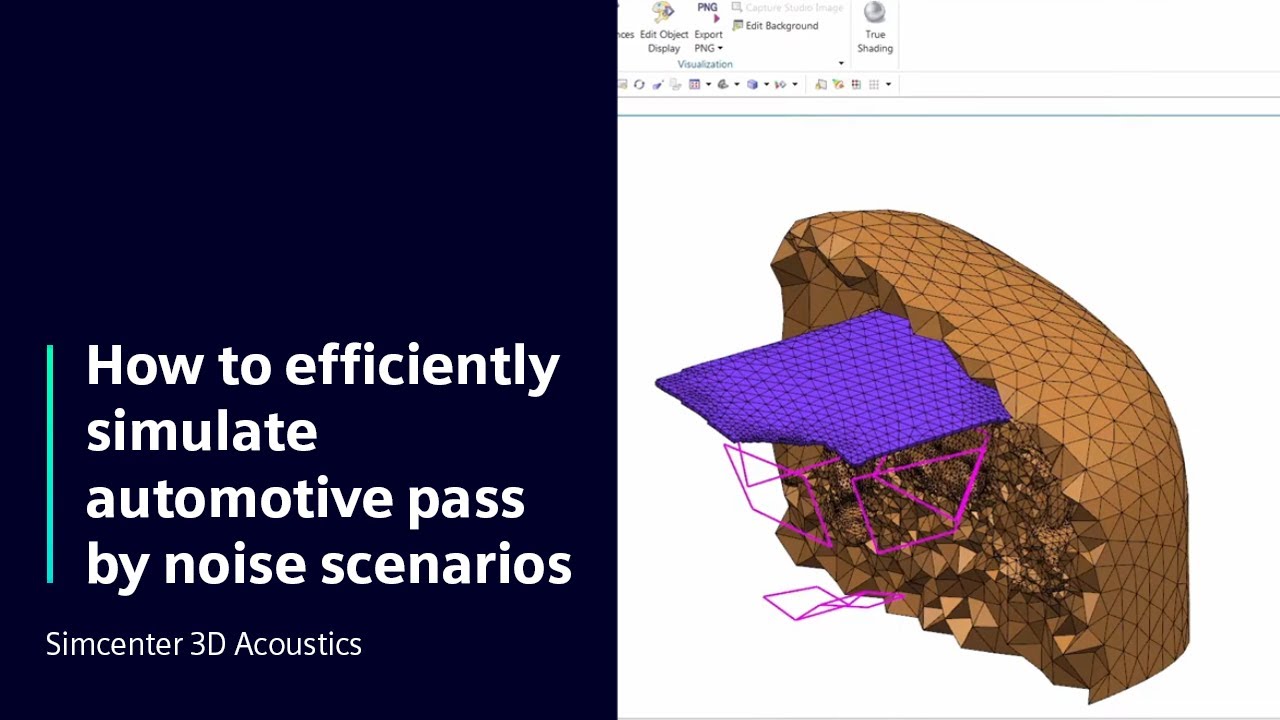
Ray acoustics simulations are now up to 50% faster for models with high source and microphone counts or those requiring higher-order diffractions. This performance gain allows teams to evaluate more design variants within the same compute budget.
For pass-by noise simulation, Simcenter 3D 2606 adds support for broadband transient sources, enabling engineers to capture the true behavior of components such as tires during a pass-by event. Direct import of Simcenter Testlab LMS files—including volume displacement, velocity, and acceleration data—means source definitions can be simulation- or test-based, broadband or tonal, stationary or transient.
Simcenter Nastran SOL401: AI-Ready Contact Convergence
The refactored SOL401 contact implementation reduces the manual tuning required to achieve convergence in nonlinear structural analyses. This is particularly valuable for automated workflows such as AI training runs and multidisciplinary optimization (MDO) studies, where consistent solver behavior is essential. SOL401 also now supports the SCD5 result format, producing lighter files that are easier to manipulate and consistent with other Simcenter solutions.
For rotor dynamics, the solver now outputs complex modes and Campbell diagrams only at critical speeds, reducing result file sizes by up to a factor of 10 while focusing attention on the data that matters most for turbomachinery design decisions.
Additive Manufacturing and Aerospace Integration
The new octree mesher for additive manufacturing creates significantly smaller models than traditional voxel meshes, especially for parts with large cross-sectional areas. Smaller models translate directly to faster solve times, enabling simulation of larger and more complex geometries without exceeding computational resource limits.
On the aerospace side, Simcenter Nastran 2606 improves coupled loads analysis workflows to generate data formats mandated by launch vehicle providers directly, reducing dependence on custom scripts and proprietary format conversion tools. Enhanced offset handling for differential stiffness in linear analysis also improves accuracy for complex airframe structures where loads do not act neatly through the structural mid-plane.
Simcenter Optistruct 2026.1
Aligned with the 2606 release, Simcenter Optistruct 2026.1 introduces adaptive mesh refinement for multi-model optimization, subcase contribution output for understanding critical load cases, and new CO₂ and cost responses that integrate sustainable design directly into optimization objectives. Advanced damage modeling for composite shells now spans both implicit and explicit solvers, and a new material model supports paperboard simulation for packaging process analysis.