
SUMO Traffic Light Optimization: Adaptive Signal Control for Urban Networks
Traffic signal optimization represents one of the most impactful applications of urban simulation, directly affecting congestion, emissions, and quality of life in cities worldwide. SUMO (Simulation of Urban MObility), an open-source traffic simulation platform developed by the German Aerospace Center (DLR), provides sophisticated tools for modeling and optimizing traffic light systems at both intersection and network levels.
Understanding SUMO's Traffic Light Control Architecture
SUMO implements traffic lights through Traffic Light Logic (TLL) definitions that specify signal phases, durations, and transitions. Unlike static timing plans, SUMO supports dynamic actuated control where signal timing responds to real-time traffic conditions. The platform's TraCI (Traffic Control Interface) enables external algorithms to modify signal states during simulation runtime, making it ideal for testing adaptive control strategies before deployment.
The tool distinguishes between fixed-time control, vehicle-actuated control, and fully adaptive systems. Fixed-time plans work well for predictable traffic patterns but fail during incidents or special events. Vehicle-actuated systems use loop detectors to extend green phases when vehicles are present, reducing unnecessary red time. Adaptive systems, which SUMO excels at modeling, continuously optimize signal timing based on network-wide traffic state.

Implementing Adaptive Signal Control Strategies
SUMO's Python-based TraCI interface allows engineers to implement sophisticated optimization algorithms. A common approach uses reinforcement learning agents that observe queue lengths, waiting times, and throughput at each intersection, then adjust signal timing to minimize network-wide delay. The simulation environment provides perfect information for training these agents before deploying them with real sensor data.
For practical implementation, SUMO supports integration with SCATS (Sydney Coordinated Adaptive Traffic System) and similar platforms through custom control scripts. Engineers can model detector placement, communication delays, and controller constraints to ensure simulated performance translates to real-world results. The platform's ability to replay actual traffic demand from detector data or GPS traces ensures validation against ground truth.
Coordination and Green Wave Optimization
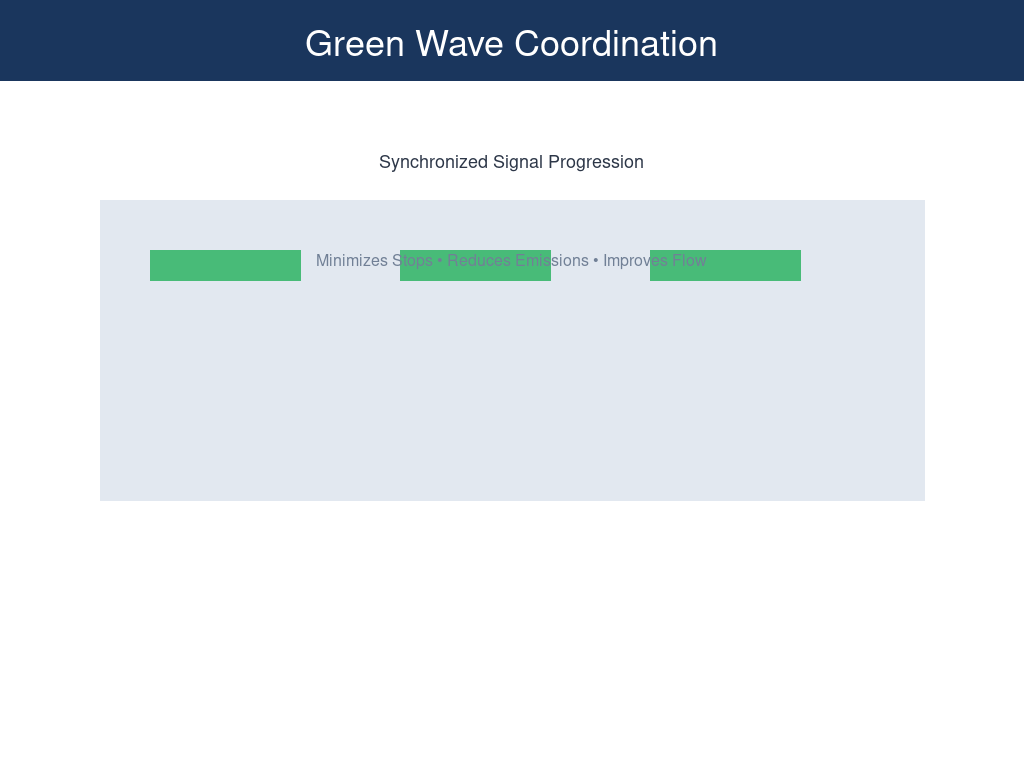
Beyond individual intersections, SUMO enables arterial coordination and green wave optimization. The tool's offset optimization algorithms synchronize adjacent signals to create progression bands where platoons travel through multiple intersections without stopping. This capability is particularly valuable for emergency vehicle preemption, where SUMO can simulate priority signal control that clears paths while minimizing disruption to general traffic.
Network-wide optimization in SUMO considers multiple objectives: minimizing total delay, reducing stops, lowering emissions, and ensuring equity across different routes. The platform's emission models (HBEFA, PHEMlight) calculate pollutant output based on acceleration profiles, allowing signal timing to explicitly target air quality improvements in sensitive areas.
Validation and Deployment Workflow
SUMO's strength lies in its validation capabilities. Engineers calibrate car-following and lane-changing parameters using real trajectory data, then validate signal optimization strategies against historical performance metrics. The platform outputs detailed statistics on delay, queue length, throughput, and emissions for each intersection and time period, enabling rigorous before-after analysis.
For deployment, SUMO-optimized timing plans export to industry-standard formats compatible with commercial signal controllers. The simulation identifies potential issues like phase conflicts, minimum green violations, or pedestrian clearance problems before field implementation. This reduces costly trial-and-error adjustments and accelerates the path from concept to operational improvement.
Conclusion
SUMO's traffic light optimization capabilities transform signal timing from an art into a data-driven engineering discipline. By providing a risk-free environment to test adaptive control strategies, coordinate arterial systems, and validate performance before deployment, SUMO enables cities to reduce congestion and emissions while improving mobility for all users. As urban traffic complexity increases, simulation-based optimization becomes not just beneficial but essential for effective traffic management.
For more information, visit the SUMO Documentation and explore the Traffic Light Control tutorials.