

COMSOL Multiphysics for Medical Device Safety: Simulating Electromagnetic Compatibility in Implantable Cardiac Devices
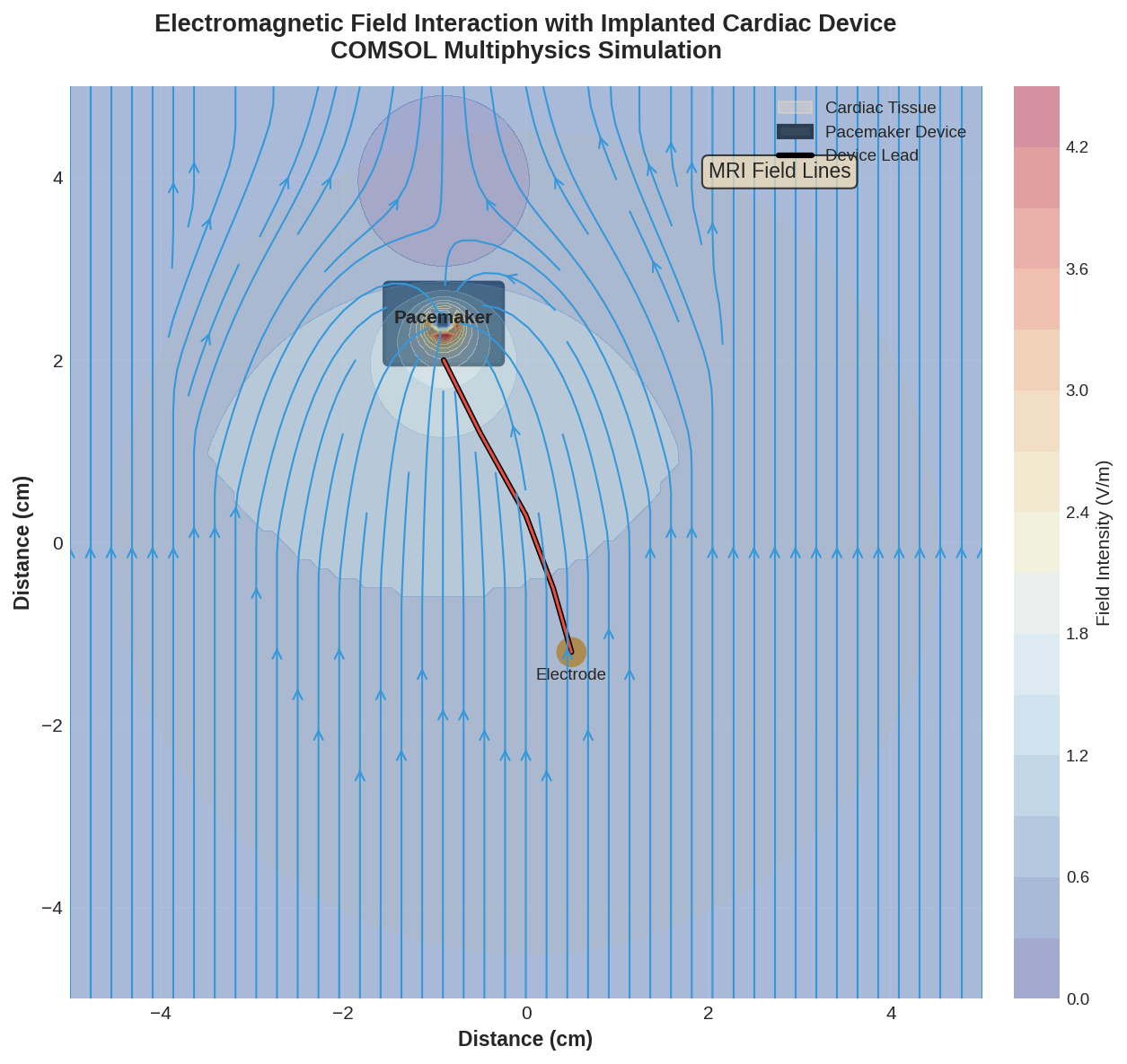
Medical device manufacturers face increasingly stringent regulatory requirements for demonstrating electromagnetic compatibility (EMC) and patient safety. COMSOL Multiphysics has emerged as a critical tool for simulating electromagnetic field interactions with implantable cardiac devices, enabling engineers to predict device behavior under various exposure scenarios before costly physical prototyping.
The Challenge of EMC Testing for Implantable Devices
Implantable cardiac devices such as pacemakers and implantable cardioverter-defibrillators (ICDs) must operate reliably in environments with electromagnetic interference from MRI scanners, wireless charging systems, security gates, and consumer electronics. Traditional physical testing is time-consuming, expensive, and limited in scope. Computational electromagnetic simulation provides a complementary approach that allows comprehensive evaluation across a wide parameter space.
COMSOL's AC/DC Module for Bioelectromagnetic Modeling
COMSOL Multiphysics offers specialized physics interfaces within its AC/DC Module specifically designed for bioelectromagnetic applications. The software couples electromagnetic field equations with thermal and structural mechanics, enabling multiphysics analysis critical for medical device safety assessment.

The Magnetic Fields interface solves Maxwell's equations in the frequency domain, allowing engineers to model induced currents in device leads and tissue heating from radiofrequency exposure. The Electric Currents interface handles conductive pathways through biological tissues with heterogeneous electrical properties, essential for predicting current density distributions around implanted electrodes.
Modeling Workflow for Cardiac Device EMC Analysis
A typical COMSOL simulation workflow for implantable device EMC assessment involves several key steps:
Geometry Construction: Engineers import CAD models of the device housing, leads, and electrodes, then embed these within anatomically realistic tissue models. COMSOL's LiveLink for CAD enables direct integration with SolidWorks, CATIA, and other design tools, maintaining parametric relationships for design optimization.
Material Property Assignment: Accurate dielectric properties, electrical conductivity, and magnetic permeability must be assigned to each tissue type and device component. COMSOL includes a comprehensive materials library with frequency-dependent properties for biological tissues based on published data from Gabriel et al. and IT'IS Foundation databases.
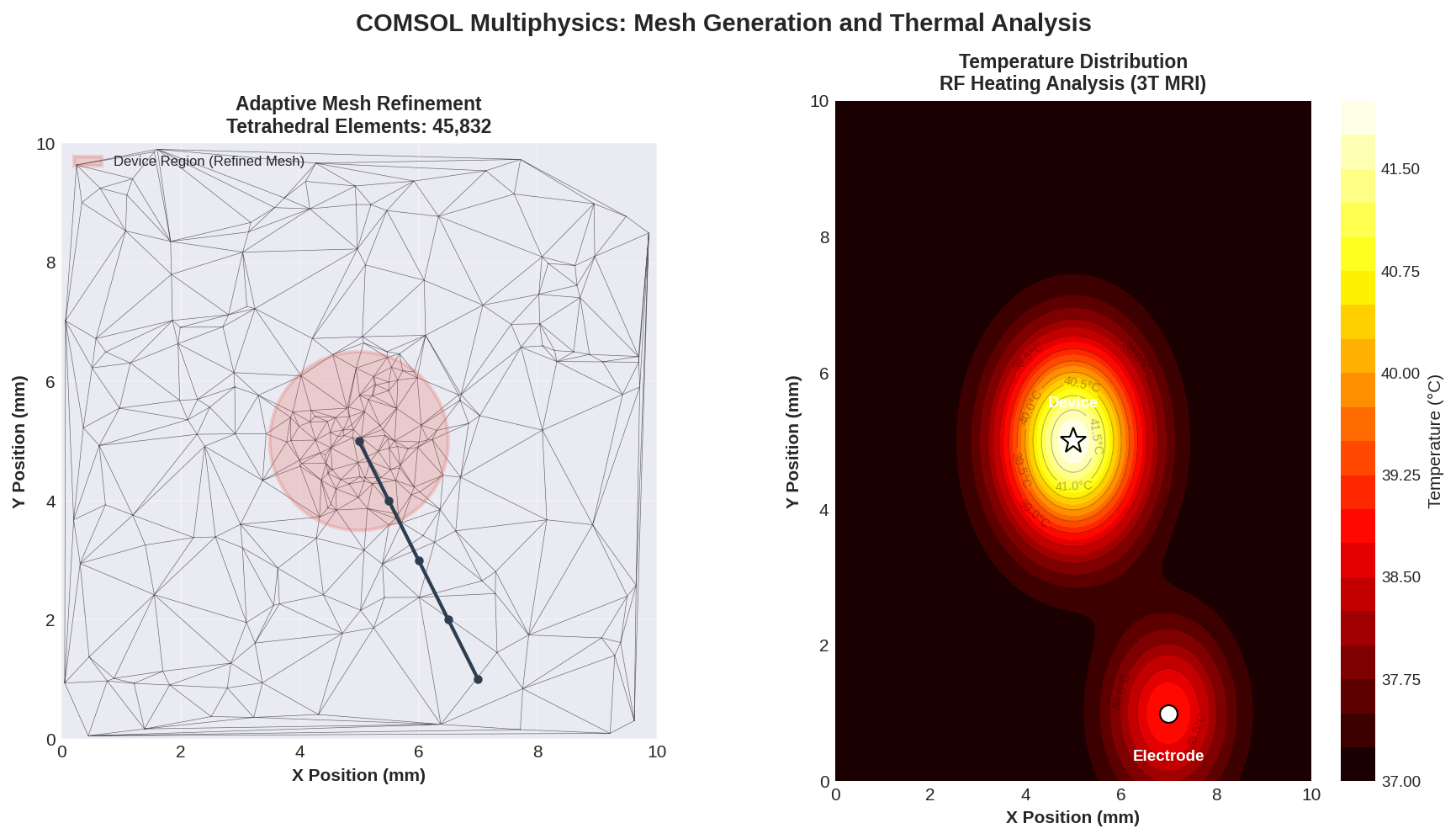
Physics Coupling: The true power of COMSOL emerges in multiphysics coupling. Electromagnetic heating is coupled to bioheat transfer equations (Pennes' equation) to predict temperature rise in tissue. Induced electric fields can be coupled to nerve stimulation models to assess potential for unintended neurostimulation.
Mesh Generation: COMSOL's physics-controlled meshing automatically refines the mesh near device surfaces and in regions with high field gradients. For electromagnetic problems, the mesh must resolve skin depths and wavelengths, typically requiring tetrahedral elements with boundary layer refinement.
Solver Configuration: Frequency-domain studies are typically used for harmonic analysis at specific frequencies (e.g., 64 MHz for 1.5T MRI, 128 MHz for 3T MRI). Time-domain solvers handle transient phenomena such as pulsed electromagnetic fields from security systems.
Validation Against ISO 14117 and IEC 60601-2-33
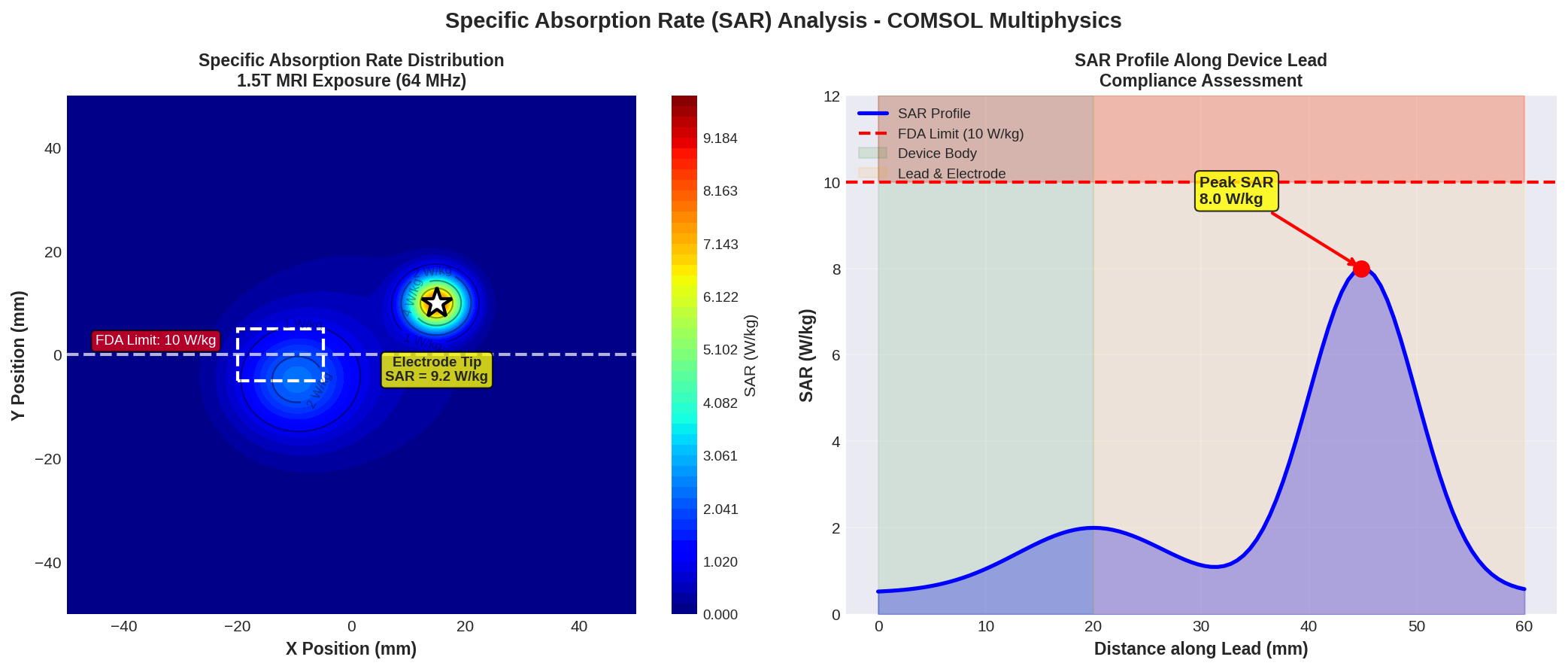
COMSOL simulations for medical devices must be validated against international standards. ISO 14117 specifies requirements for active implantable medical devices regarding electromagnetic immunity, while IEC 60601-2-33 addresses MRI safety. Engineers use COMSOL to demonstrate compliance by:
- Calculating specific absorption rate (SAR) distributions and comparing against FDA limits (typically 10 W/kg averaged over 10g of tissue for implant heating)
- Predicting induced voltages at electrode-tissue interfaces that could cause cardiac capture or fibrillation
- Evaluating electromagnetic force on ferromagnetic components in gradient magnetic fields
- Assessing reed switch activation thresholds under various field exposures
Advanced Features: Uncertainty Quantification and Optimization
Recent COMSOL versions include the Optimization Module and Uncertainty Quantification Module, enabling probabilistic analysis of device performance. Engineers can perform Monte Carlo simulations accounting for variability in tissue properties, device positioning, and patient anatomy. This statistical approach provides confidence intervals for safety margins rather than single-point estimates.
The optimization capabilities allow automated design refinement. For example, lead geometry and shielding configurations can be optimized to minimize induced currents while maintaining therapeutic efficacy. Gradient-based and genetic algorithms are available depending on the problem structure.
Integration with Clinical Workflow
COMSOL's simulation results increasingly inform clinical decision-making. Patient-specific models derived from CT or MRI scans can be imported via DICOM, allowing personalized risk assessment before MRI procedures. The Application Builder enables creation of custom interfaces that clinicians can use without deep simulation expertise, democratizing access to computational predictions.
Computational Requirements and Best Practices
Electromagnetic simulations of implantable devices are computationally intensive. A typical 3T MRI exposure simulation with anatomically detailed tissue models may require 64-256 GB RAM and several hours on a multi-core workstation. COMSOL supports distributed computing via the Cluster Computing functionality, enabling solution of models with tens of millions of degrees of freedom.
Best practices include:
- Using symmetry planes to reduce model size when applicable
- Employing infinite element domains to truncate far-field boundaries
- Leveraging adaptive mesh refinement to focus computational resources
- Validating simplified models against analytical solutions before full-scale simulation
Regulatory Acceptance and Future Directions
The FDA's Center for Devices and Radiological Health increasingly accepts computational modeling as evidence in premarket submissions through the Medical Device Development Tools (MDDT) program. COMSOL models that follow best practices outlined in ASME V&V 40 (verification and validation in computational modeling of medical devices) can reduce the burden of physical testing.
Future developments include integration of machine learning surrogate models to accelerate parametric studies, enhanced coupling with computational fluid dynamics for drug-eluting devices, and real-time simulation capabilities for surgical planning applications.
Resources and Further Reading
- COMSOL Multiphysics Documentation: www.comsol.com/documentation
- FDA Guidance on Computational Modeling: www.fda.gov/medical-devices/science-and-research-medical-devices/computational-modeling
- ASME V&V 40 Standard: www.asme.org/codes-standards/find-codes-standards/v-v-40-assessing-credibility-computational-modeling-verification-validation-application-medical-devices
- IT'IS Foundation Tissue Properties Database: itis.swiss/virtual-population/tissue-properties/overview
COMSOL Multiphysics provides medical device engineers with a comprehensive platform for electromagnetic safety assessment, enabling faster development cycles, reduced testing costs, and ultimately safer implantable devices for patients.