

DWSIM Distillation Column Design: Rigorous Tray-by-Tray Calculations for Multi-Component Separations
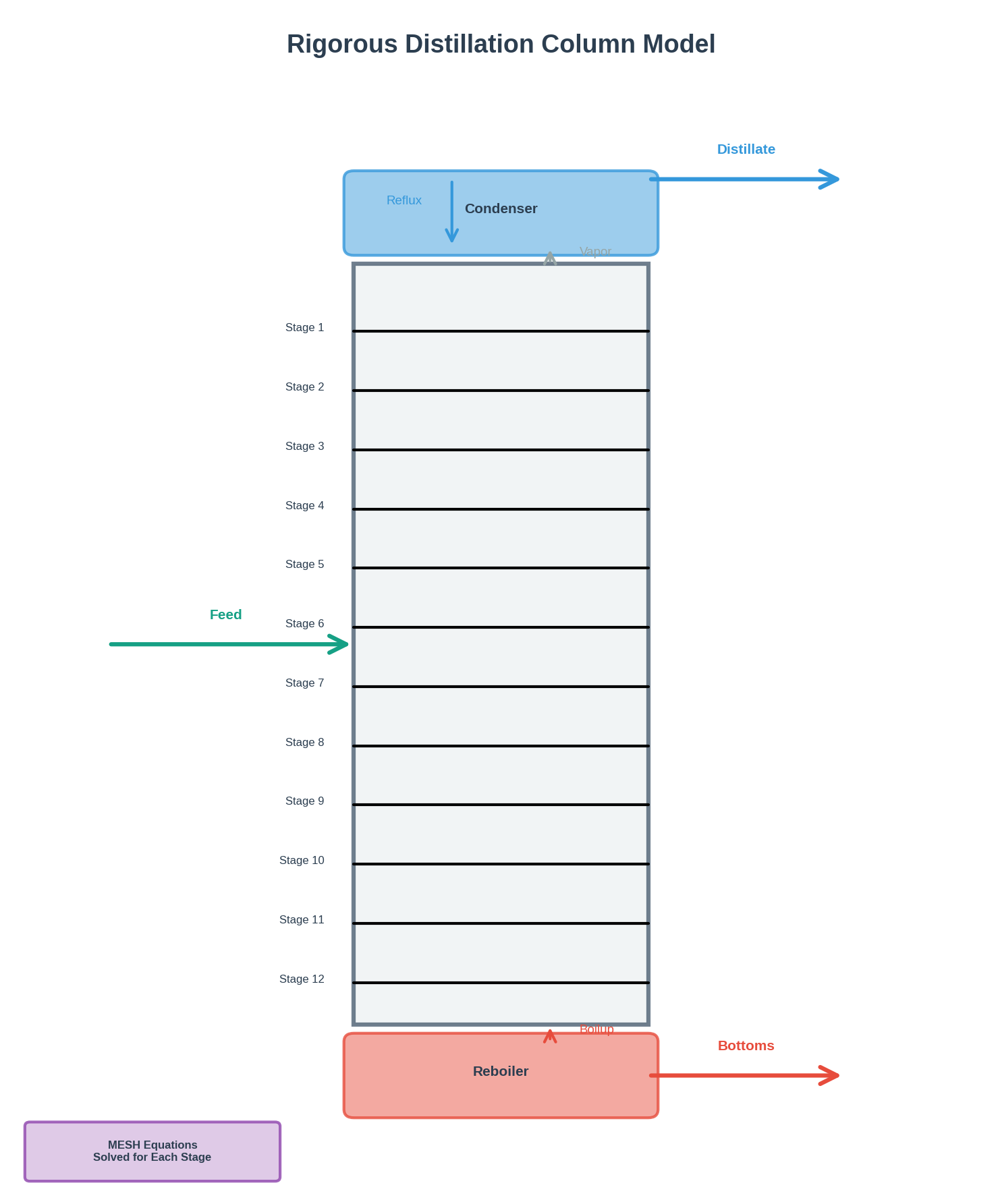
Distillation remains the most widely used separation technique in chemical process industries, accounting for approximately 95% of all industrial separations. While simplified shortcut methods provide quick estimates, rigorous tray-by-tray calculations are essential for accurate column design, troubleshooting existing operations, and optimizing energy consumption. DWSIM, an open-source process simulator, offers powerful rigorous distillation modeling capabilities that rival commercial packages, making advanced separation analysis accessible to engineers worldwide.
Understanding Rigorous Distillation Models
Unlike shortcut methods (Fenske-Underwood-Gilliland) that assume constant relative volatility and theoretical stages, rigorous models solve the complete MESH equations (Material balance, Equilibrium, Summation, and Heat balance) for each tray simultaneously. This approach accounts for:
- Non-ideal vapor-liquid equilibrium using activity coefficient models (NRTL, UNIQUAC, Wilson)
- Temperature and composition variations throughout the column
- Tray hydraulics and efficiency factors
- Multiple feeds, side draws, and intermediate condensers/reboilers
- Heat integration and energy optimization opportunities
DWSIM implements several rigorous algorithms including the Inside-Out method, which combines the robustness of simple iteration with the speed of Newton-Raphson convergence. This hybrid approach makes it particularly effective for difficult separations involving azeotropes, wide-boiling mixtures, or reactive distillation systems.

Setting Up a Rigorous Distillation Column in DWSIM
The workflow for rigorous distillation modeling in DWSIM follows a systematic approach:
1. Thermodynamic Package Selection
Choose an appropriate property method based on your system characteristics. For hydrocarbon systems, Peng-Robinson or SRK equations of state work well. For polar or associating compounds (alcohols, acids, water), activity coefficient models like NRTL or UNIQUAC provide better accuracy. DWSIM's extensive compound database includes parameters for thousands of chemicals, and users can add custom compounds with experimental data.
2. Column Configuration
Define the number of theoretical stages, feed locations, and operating pressure profile. DWSIM allows pressure drop specifications per stage, which is critical for vacuum distillation or high-pressure columns where pressure effects significantly impact equilibrium. The software supports multiple feed streams at different stages, enabling complex configurations like divided-wall columns or side-rectifier arrangements.
3. Specification Strategy
Rigorous models require exactly N+2 specifications for an N-stage column (where N includes condenser and reboiler). Common specification sets include:
- Reflux ratio + distillate flow rate
- Reflux ratio + bottoms product composition
- Two product compositions (requires iterative adjustment of reflux and boilup)
DWSIM's specification matrix allows flexible combinations, and the software automatically checks for degrees of freedom consistency.
4. Convergence Parameters
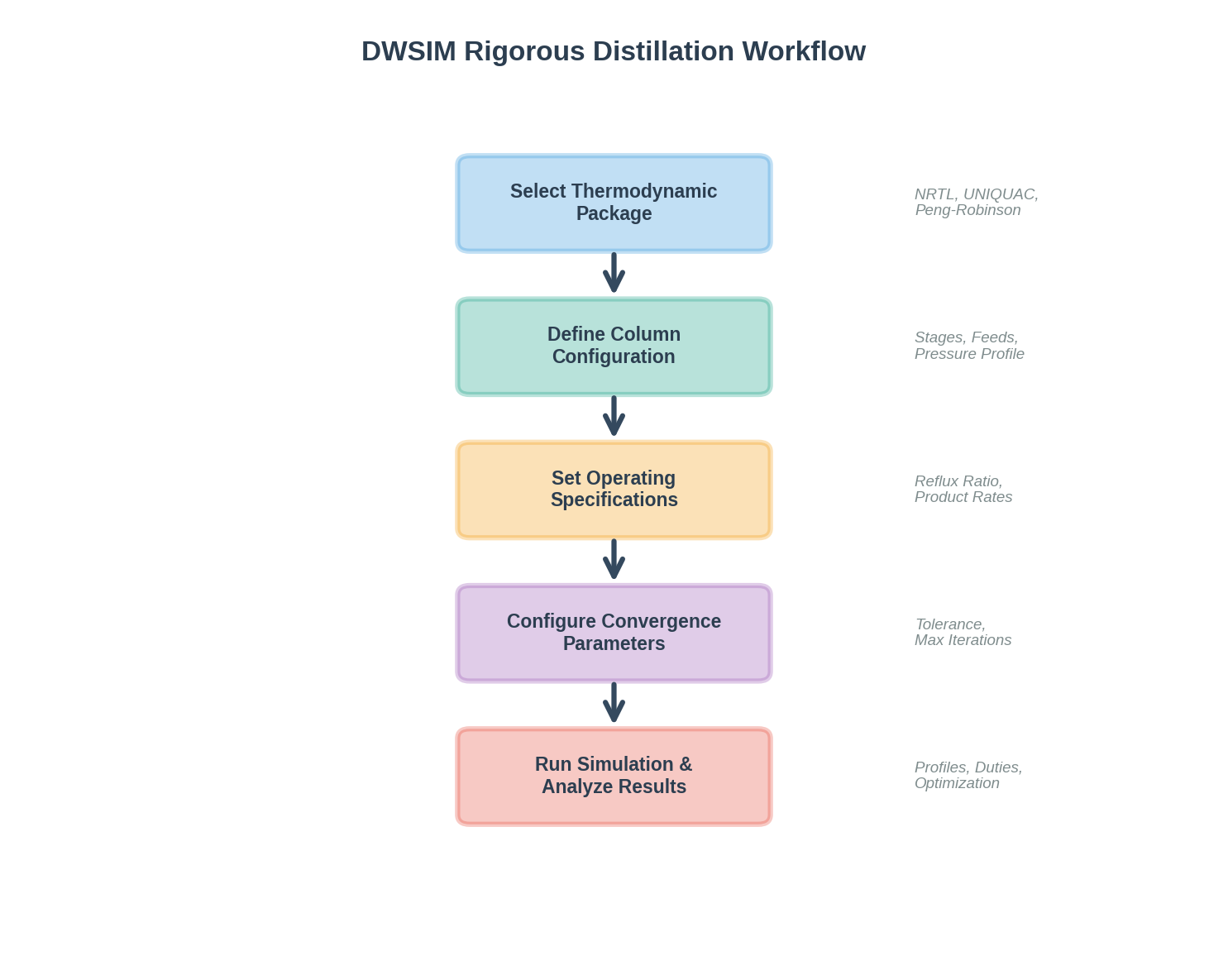
Set appropriate tolerance levels (typically 1e-4 to 1e-6 for composition convergence) and maximum iterations. For difficult separations, using a shortcut method to generate initial estimates significantly improves convergence. DWSIM's "Use Shortcut Results as Initial Estimates" option automates this process.
Advanced Features for Process Optimization
DWSIM's rigorous distillation module includes several advanced capabilities that extend beyond basic column simulation:
Sensitivity Analysis
Engineers can systematically vary operating parameters (reflux ratio, feed stage location, pressure) to identify optimal operating conditions. The built-in sensitivity analysis tool generates parametric studies showing how key performance indicators (product purity, energy consumption, separation efficiency) respond to design changes.
Column Profile Visualization
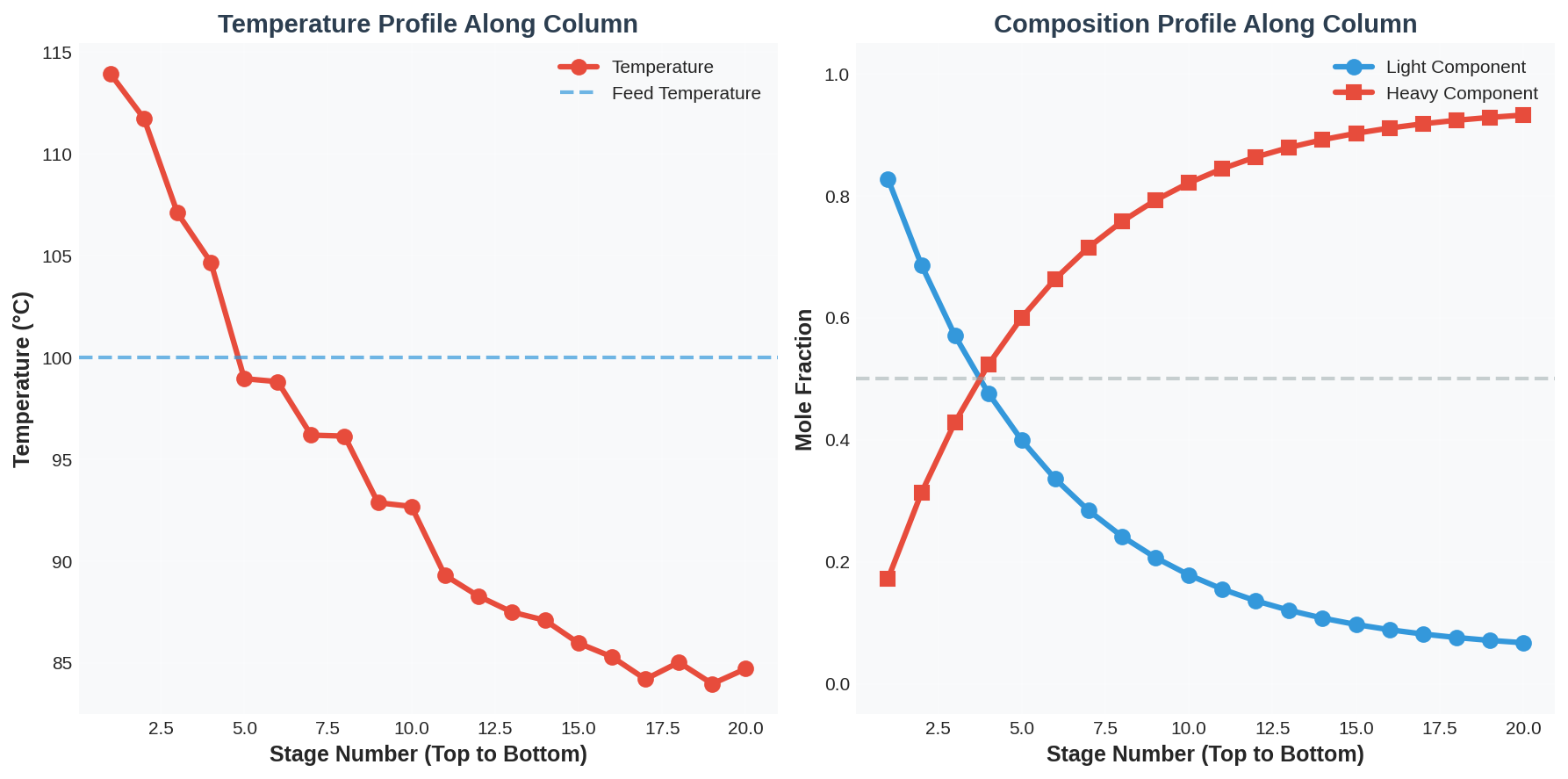
DWSIM generates comprehensive temperature, composition, and flow profiles for each stage. These profiles reveal pinch zones where separation becomes difficult, helping engineers identify opportunities for feed preheating, intermediate reboilers, or alternative separation sequences.
Energy Integration
The software calculates condenser duty, reboiler duty, and stage-by-stage heat requirements. This information feeds directly into heat exchanger network design and pinch analysis, enabling systematic energy optimization across the entire process.
Tray Efficiency Modeling
Real columns don't achieve theoretical equilibrium on each tray. DWSIM allows users to specify Murphree tray efficiencies (overall or component-specific) or use empirical correlations based on tray geometry and fluid properties. This bridges the gap between theoretical design and actual column performance.
Practical Applications and Case Studies
Rigorous distillation modeling in DWSIM proves invaluable for several industrial scenarios:
Debottlenecking Existing Columns
When plant capacity increases or feed composition changes, rigorous models predict whether existing columns can handle new conditions. Engineers can evaluate the impact of increased throughput on product quality, flooding limits, and energy consumption without costly pilot testing.
Azeotropic Separations
Systems forming azeotropes (ethanol-water, acetone-chloroform) require pressure-swing or extractive distillation. DWSIM's rigorous models accurately predict azeotrope composition shifts with pressure and evaluate entrainer effectiveness in extractive distillation schemes.
Reactive Distillation
For equilibrium-limited reactions (esterification, etherification), combining reaction and separation in a single column improves conversion and reduces capital costs. DWSIM supports reactive distillation modeling by incorporating reaction kinetics into the MESH equations, allowing simultaneous optimization of reaction and separation performance.
Best Practices for Reliable Results
To ensure accurate and reliable rigorous distillation simulations:
- Validate thermodynamic models against experimental VLE data for your specific system
- Start with reasonable initial estimates using shortcut methods or similar operating data
- Check material and energy balances - errors indicate convergence problems or specification inconsistencies
- Verify physical feasibility - ensure temperatures, pressures, and compositions fall within realistic ranges
- Perform sensitivity analysis to understand how uncertainties in feed conditions or physical properties affect results
Conclusion
DWSIM's rigorous distillation modeling capabilities provide chemical engineers with industrial-grade simulation tools at no cost. By solving the complete MESH equations with robust numerical methods, the software delivers accurate predictions for complex multi-component separations. Whether designing new columns, optimizing existing operations, or troubleshooting separation problems, DWSIM's rigorous approach offers the detail and accuracy required for confident engineering decisions.
For engineers seeking to deepen their understanding of distillation fundamentals while leveraging modern computational tools, DWSIM represents an ideal platform. Its open-source nature encourages experimentation and learning, while its rigorous modeling capabilities ensure results suitable for industrial applications.
Further Resources:
- DWSIM Official Documentation: https://dwsim.org/wiki/
- Distillation Design and Control Using Aspen Simulation (Luyben) - principles apply to DWSIM
- Perry's Chemical Engineers' Handbook - Chapter 13: Distillation
- DWSIM User Forum: https://sourceforge.net/p/dwsim/discussion/