

GATE Monte Carlo Simulation: Optimizing PET/SPECT Scanner Design and Dosimetry in Nuclear Medicine
Introduction
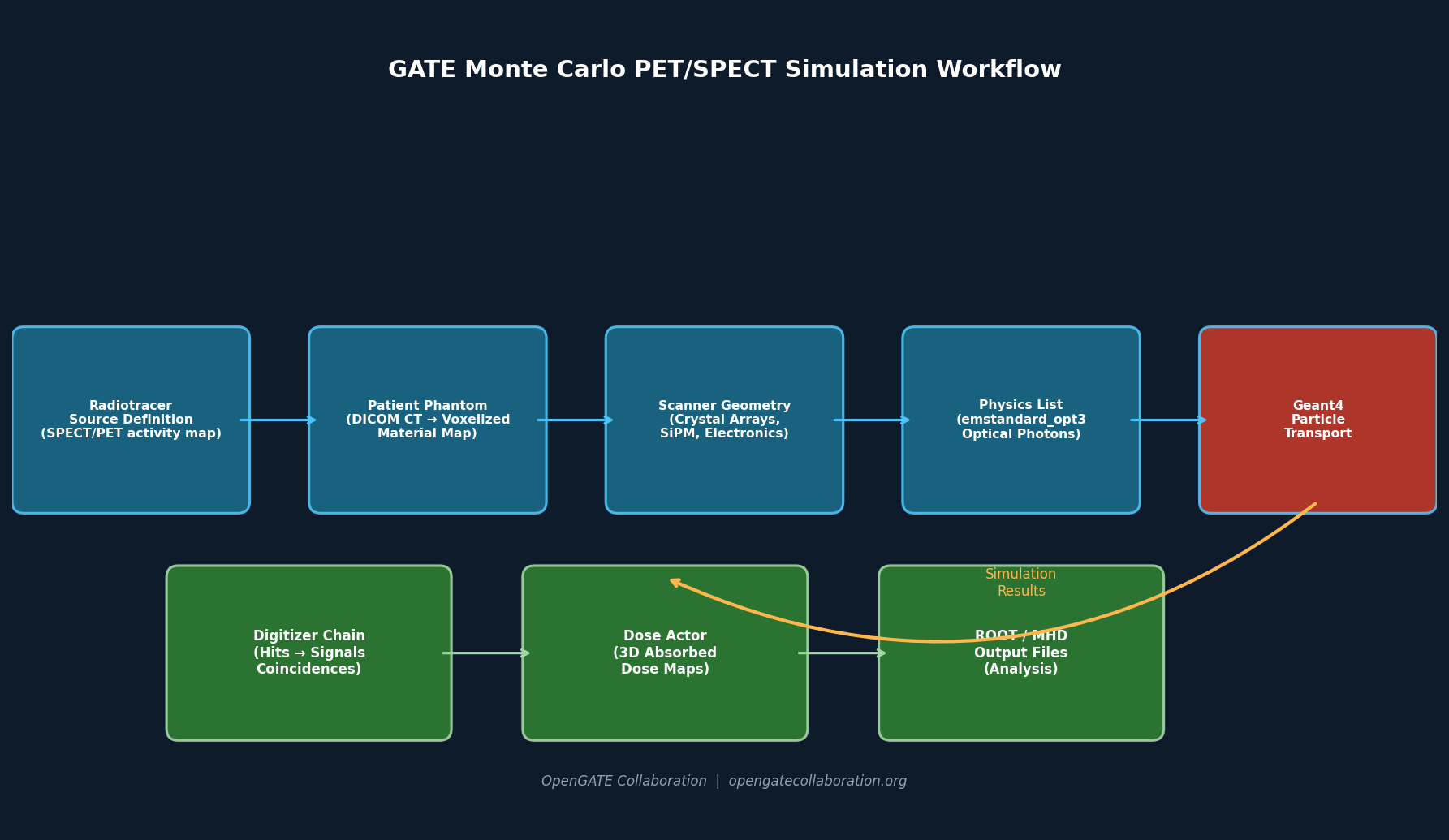
Nuclear medicine imaging—positron emission tomography (PET) and single-photon emission computed tomography (SPECT)—depends on the precise interaction of ionizing radiation with detector materials and patient tissue. Designing scanners that maximize sensitivity while minimizing patient dose requires modeling photon transport at the quantum level, a task that analytical methods cannot reliably accomplish. GATE (Geant4 Application for Tomographic Emission) is the industry-standard open-source Monte Carlo simulation platform purpose-built for this challenge.
Developed and maintained by the OpenGATE Collaboration, GATE wraps the Geant4 particle physics toolkit in a domain-specific macro language and Python API, enabling medical physicists and biomedical engineers to simulate complete imaging systems—from radiotracer decay through detector response to image reconstruction—without writing low-level C++ code.
Why Monte Carlo for Nuclear Medicine?
Analytical models of photon transport rely on simplifying assumptions (e.g., narrow-beam geometry, homogeneous attenuation) that break down in realistic scanner geometries and heterogeneous patient anatomy. Monte Carlo methods instead track individual photon histories stochastically, sampling interaction cross-sections from validated physics databases. This yields:

- Accurate scatter fractions in PET coincidence detection, critical for quantitative SUV measurements
- Realistic detector dead-time and pile-up modeling under high-activity conditions
- Patient-specific absorbed dose maps for dosimetry in targeted radionuclide therapy (TRT)
- System sensitivity and spatial resolution predictions before physical prototyping
GATE has been validated against experimental data for clinical scanners including the Siemens Biograph mCT, GE Discovery MI, and Philips Vereos, with sensitivity agreement typically within 2–5%.
Core Architecture: Geometry, Physics, and Actors
Geometry Definition
GATE uses a hierarchical volume system built on Geant4 solids. A typical PET scanner is defined as:
- World volume — air-filled bounding box
- Scanner ring — cylindrical assembly of detector blocks
- Crystal array — individual LYSO or BGO scintillator elements (e.g., 4 × 4 × 20 mm)
- Patient phantom — XCAT digital phantom or patient-specific CT-derived voxelized geometry
Voxelized phantoms are imported from DICOM CT series using the ImageNestedParametrisedVolume actor, with Hounsfield-unit-to-material conversion tables mapping each voxel to tissue composition and density.
Physics Lists
GATE provides pre-configured physics lists optimized for medical imaging energies (10 keV–10 MeV):
| Physics List | Application |
|---|---|
emstandard_opt3 |
General PET/SPECT, balanced accuracy/speed |
emlivermore |
Low-energy photon transport (<1 keV), fluorescence |
empenelope |
Electron transport in detector materials |
QGSP_BIC_HP |
Neutron activation, prompt gamma imaging |
For PET simulation, the OpticalPhoton process can be enabled to model scintillation light propagation within crystal arrays, enabling detector energy resolution and timing jitter characterization.
Digitizer Chain
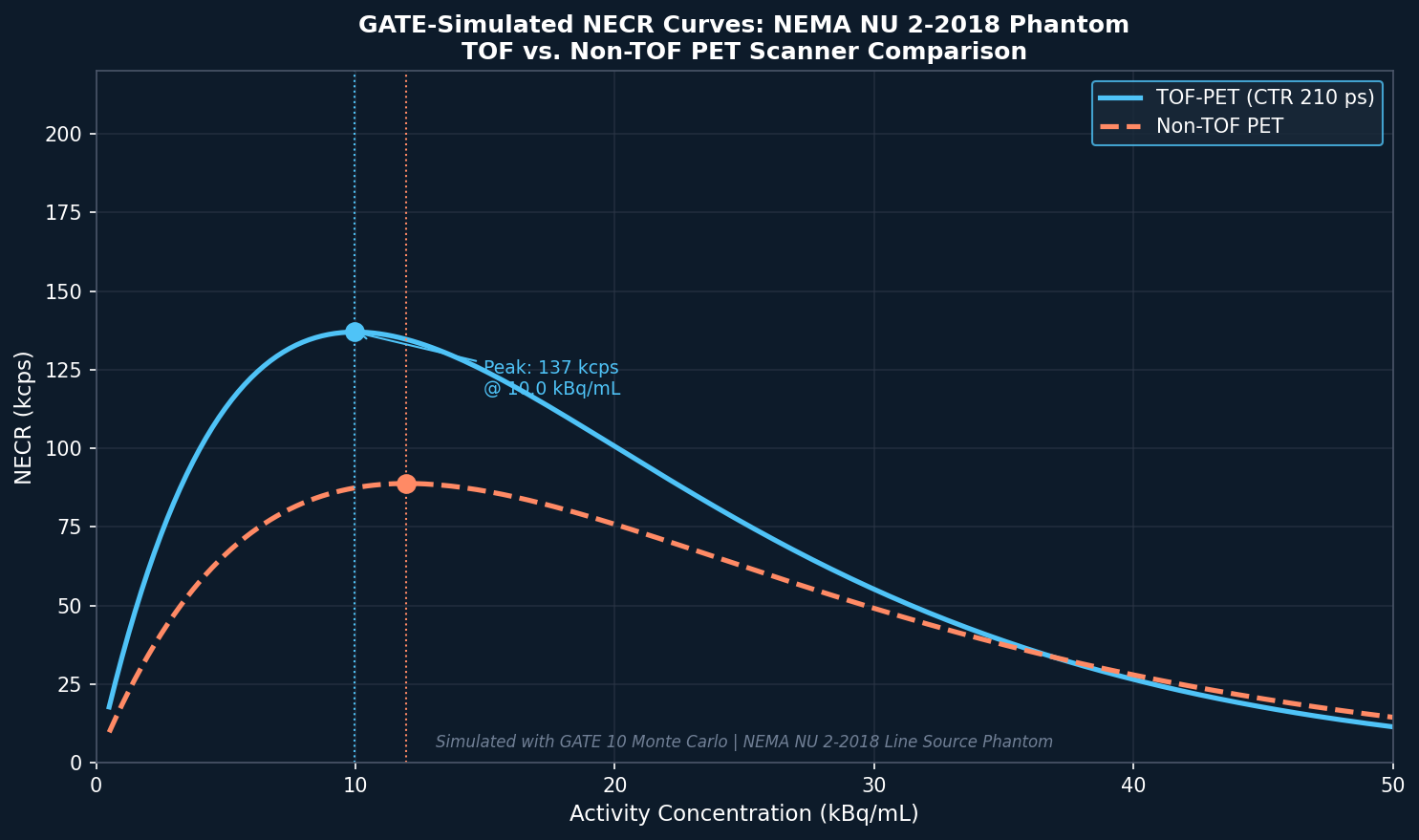
The digitizer converts raw energy depositions ("hits") into realistic detector signals through a configurable pipeline:
Hits → Adder → Readout → Energy Blurring → Thresholder → Coincidence SorterKey modules include:
- Energy blurring: Gaussian smearing parameterized by measured energy resolution (e.g., 11% FWHM at 511 keV for LYSO)
- Dead time: Paralyzable or non-paralyzable models per detector block
- Coincidence sorter: Time window (typically 4–6 ns), delayed window for random estimation, and multiple-coincidence handling
Key Simulation Workflows
1. Scanner Sensitivity and Noise Equivalent Count Rate (NECR)
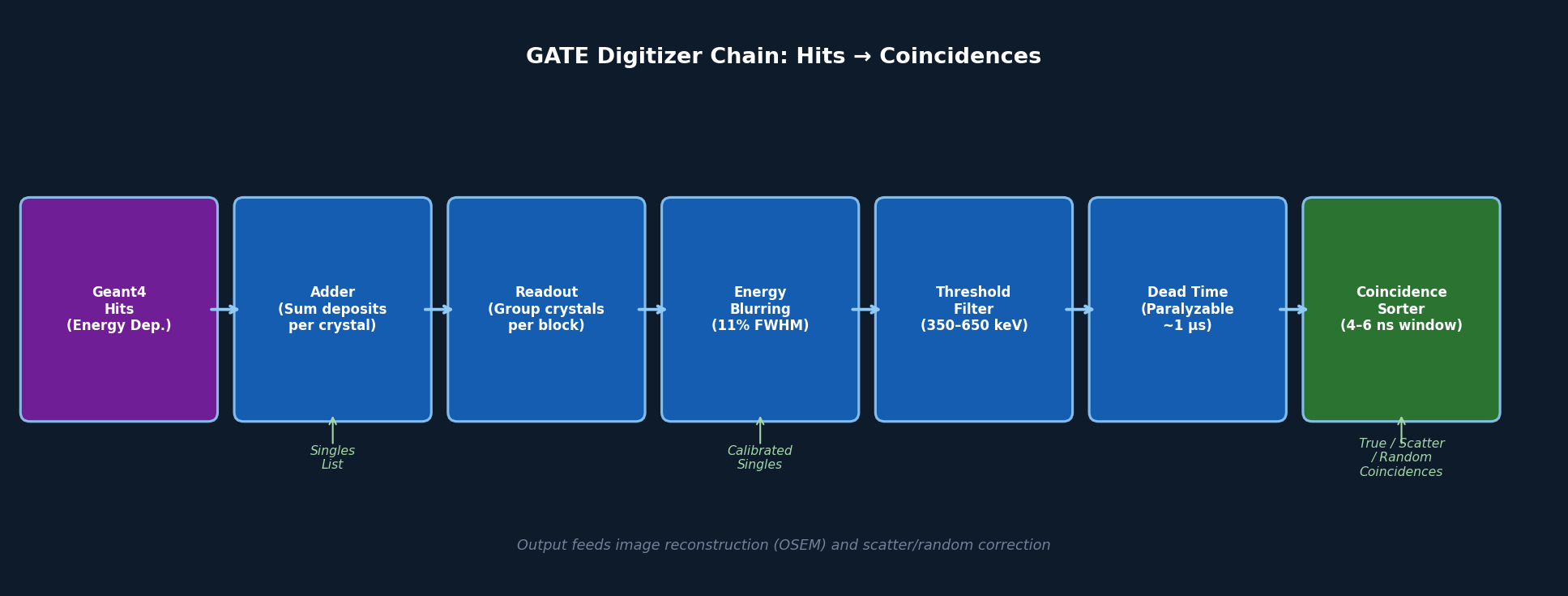
NECR characterization per NEMA NU 2-2018 is a standard GATE validation workflow. A line source phantom (20 cm diameter HDPE cylinder, 70 cm length) is simulated with activity concentrations from 0.5 to 50 kBq/mL. GATE outputs true, scattered, and random coincidence rates, from which NECR is computed:
NECR = T² / (T + S + R)Simulated NECR curves for modern TOF-PET systems peak at 150–200 kcps at ~10 kBq/mL, consistent with published scanner specifications.
2. Dosimetry for Targeted Radionuclide Therapy
For [177Lu]Lu-DOTATATE therapy planning, GATE simulates the absorbed dose to tumor and organs-at-risk from patient-specific SPECT/CT activity distributions. The workflow:
- Import segmented SPECT activity map as source volume
- Define patient anatomy from CT-derived voxelized phantom
- Simulate 10⁷–10⁸ primary decays (Lu-177 beta + gamma spectrum)
- Score absorbed dose using
DoseActoron a 4 mm³ voxel grid - Export 3D dose maps as MHD/MHA files for treatment planning integration
Dose uncertainty of <2% per voxel is achievable with ~10⁸ primaries on a modern GPU cluster using GATE's OpenCL backend.
3. Time-of-Flight (TOF) PET Optimization
TOF resolution directly impacts image SNR. GATE enables systematic optimization of crystal geometry, SiPM coupling, and electronics timing by parameterizing coincidence time resolution (CTR) as a function of crystal length and reflector configuration. Simulations have guided the design of sub-200 ps CTR systems, enabling whole-body PET at reduced injected activity.
GPU Acceleration with GATE 10
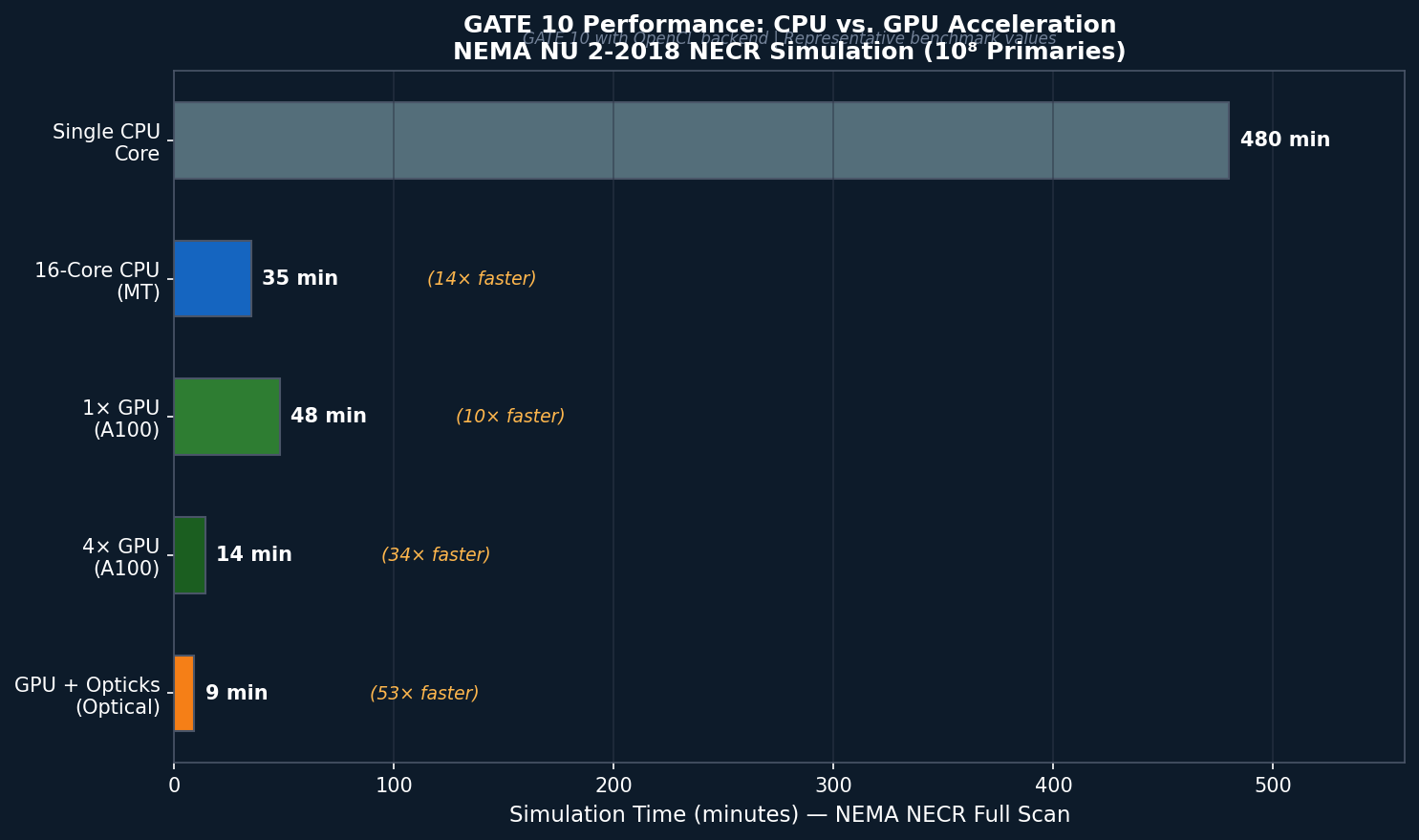
GATE 10 (released 2023) introduced a complete rewrite based on Geant4 11 with native GPU support via the opticks photon simulation library and FRED GPU Monte Carlo engine integration. Key performance improvements:
- 10–50× speedup for optical photon transport in scintillator arrays
- Multithreaded CPU execution with near-linear scaling to 64+ cores
- Python-based macro system replacing the legacy macro language, enabling parametric studies and integration with optimization frameworks (e.g., Optuna, scikit-optimize)
A full NEMA NECR simulation that required 8 hours on a single CPU core now completes in under 20 minutes on a 4-GPU workstation.
Regulatory and Clinical Context
GATE simulations are increasingly accepted in regulatory submissions for novel scanner designs and dosimetry protocols. The EANM Dosimetry Committee and MIRD Committee have published guidance endorsing Monte Carlo dosimetry for TRT, with GATE cited as a reference implementation. For FDA 510(k) submissions involving PET detector modules, GATE-derived sensitivity and resolution data can supplement or reduce the scope of physical phantom measurements, provided simulation validation against NEMA standards is documented.
Getting Started
GATE is freely available at opengatecollaboration.org under the GNU LGPL license. The recommended installation path is via the official Docker container:
docker pull opengatecollaboration/gate:10.0
docker run -it --gpus all opengatecollaboration/gate:10.0
The GATE user guide provides worked examples for PET, SPECT, CT, and dosimetry applications. The GateBenchmarks repository on GitHub maintains regression test suites against experimental data for 15+ clinical scanner models.
Conclusion
GATE provides nuclear medicine physicists and biomedical engineers with a validated, flexible Monte Carlo platform that spans the full simulation chain from radiotracer physics to detector response. Its combination of Geant4's physics accuracy, domain-specific abstractions, and modern GPU acceleration makes it the tool of choice for PET/SPECT scanner optimization, dosimetry in targeted radionuclide therapy, and regulatory-grade system characterization. As imaging systems push toward sub-200 ps TOF resolution and total-body PET geometries, GATE's ability to model complete systems at the photon level will remain indispensable.