
Monolix Population PK-PD Modeling: Nonlinear Mixed-Effects Estimation for Drug Development
Population pharmacokinetic-pharmacodynamic (PK-PD) modeling is a cornerstone of modern drug development, enabling researchers to characterize drug behavior across diverse patient populations and optimize dosing regimens before costly clinical trials. Monolix, developed by Lixoft (a Simulations Plus company), is a leading software platform for nonlinear mixed-effects (NLME) modeling that has become the tool of choice for regulatory submissions and translational pharmacology teams worldwide.
What Is Population PK-PD Modeling?
Unlike traditional compartmental analysis that fits a single patient's data, population modeling simultaneously analyzes data from all subjects in a study. The NLME framework decomposes observed variability into:
- Fixed effects (typical population parameters, e.g., clearance CL, volume of distribution V)
- Random effects (between-subject variability, BSV)
- Residual unexplained variability (RUV, capturing measurement error and model misspecification)
This approach extracts maximum information from sparse sampling designs—critical in pediatric studies, oncology trials, and Phase I dose-escalation studies where full PK profiles per patient are impractical.

Monolix's SAEM Algorithm: Why It Matters
The computational engine behind Monolix is the Stochastic Approximation Expectation-Maximization (SAEM) algorithm, which offers decisive advantages over traditional FOCE (First-Order Conditional Estimation) methods used in NONMEM:
- Exact likelihood estimation: SAEM does not rely on linearization approximations, making it more accurate for highly nonlinear models and large BSV
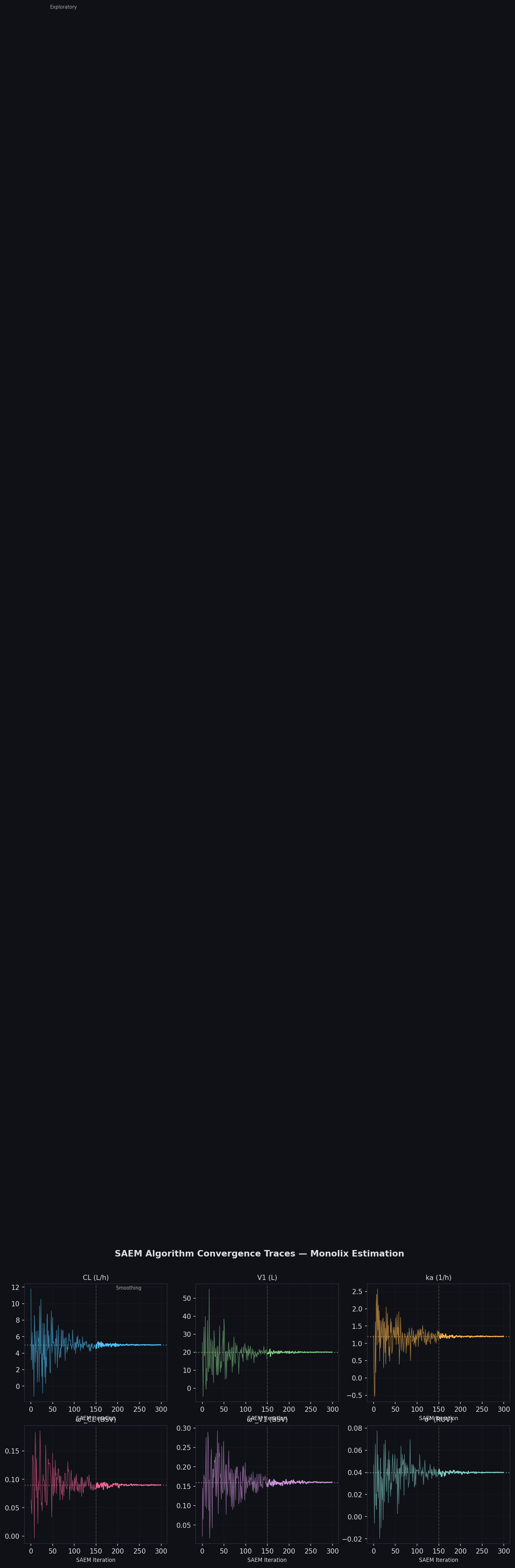
- Convergence robustness: The stochastic component prevents entrapment in local optima—a common failure mode with gradient-based optimizers
- Automatic initialization: Monolix's SAEM implementation includes automated exploratory and smoothing phases, reducing the need for manual tuning of initial estimates
In benchmark studies comparing SAEM to FOCE-I on complex PK-PD models (e.g., target-mediated drug disposition, TMDD), SAEM consistently achieves lower objective function values and better parameter recovery, particularly when BSV exceeds 50%.
Building a Two-Compartment PK Model in Monolix
A typical workflow for a two-compartment model with first-order absorption illustrates Monolix's structured approach:
1. Model Library Selection
Monolix ships with an extensive built-in library of structural models (PK, PD, PKPD, disease progression). For a two-compartment oral model, users select lib:oral2cpt_kaClV1QV2 directly from the GUI—no manual ODE coding required for standard models.
2. Statistical Model Specification
Each parameter (ka, CL, V1, Q, V2) receives:
- A log-normal distribution (ensuring positivity)
- A BSV term (η_i ~ N(0, ω²))
- Optional covariate relationships (e.g., CL ~ body weight via allometric scaling)
3. Covariate Model Building
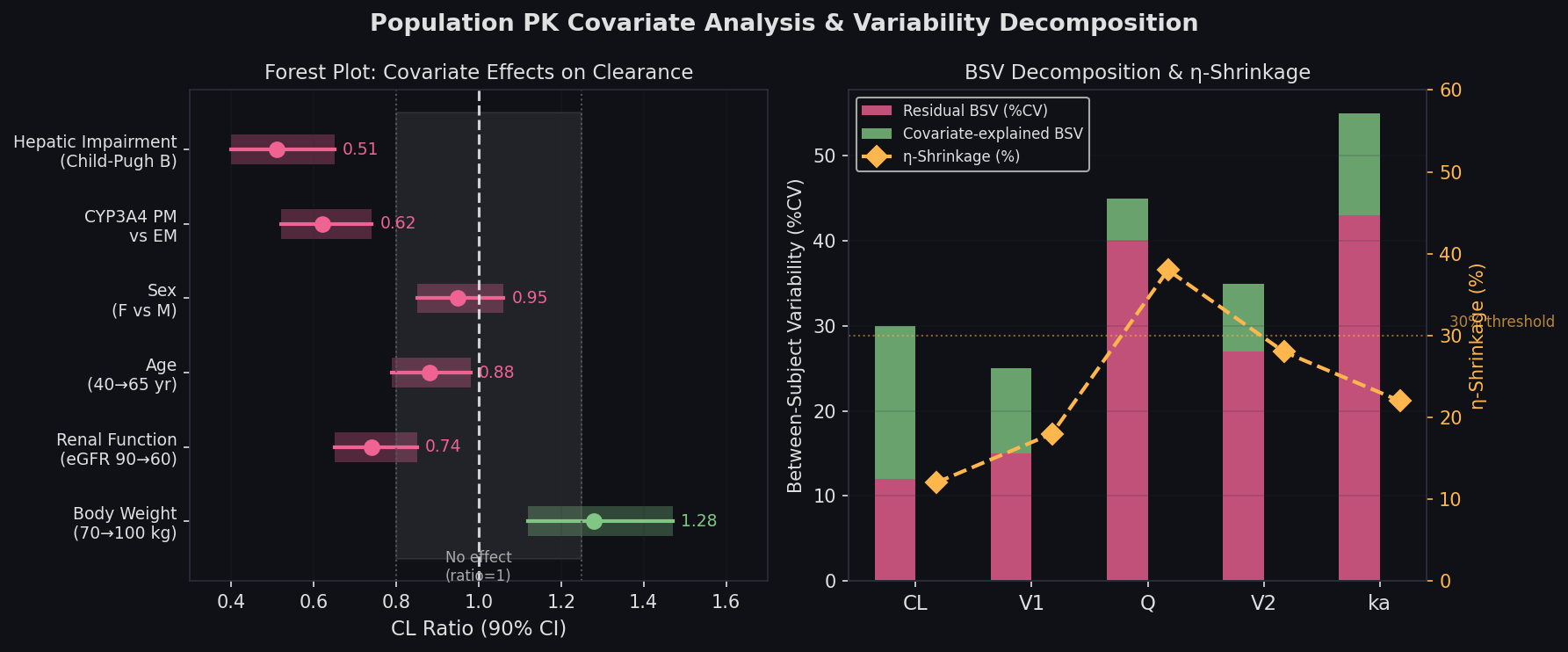
Monolix's Covariate Model Building (COSSAC algorithm) automates stepwise covariate selection, testing continuous covariates (weight, age, renal function) and categorical covariates (sex, genotype) against all parameters simultaneously. This replaces the laborious manual forward-inclusion/backward-elimination process.
4. Estimation and Diagnostics
After SAEM convergence, Monolix generates:
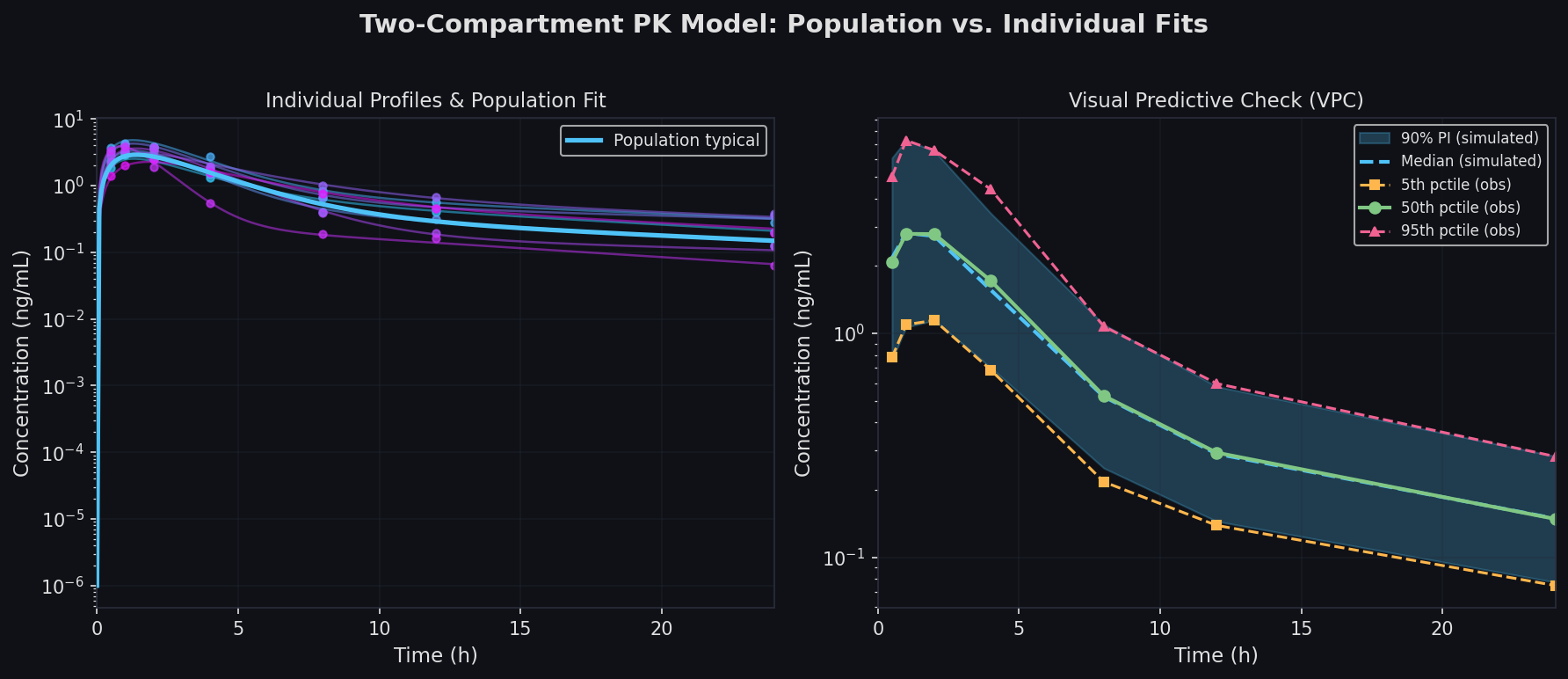
- Individual fits overlaid on observed data
- VPC (Visual Predictive Check): simulated prediction intervals vs. observed percentiles—the gold standard for model qualification
- NPDE (Normalized Prediction Distribution Errors): a distribution-free diagnostic for detecting systematic model misspecification
- Bootstrap confidence intervals for parameter uncertainty
PK-PD Linking: Emax and Indirect Response Models
Monolix excels at linking PK models to pharmacodynamic endpoints. Common PD model structures include:
Emax (sigmoidal) model for direct effects:
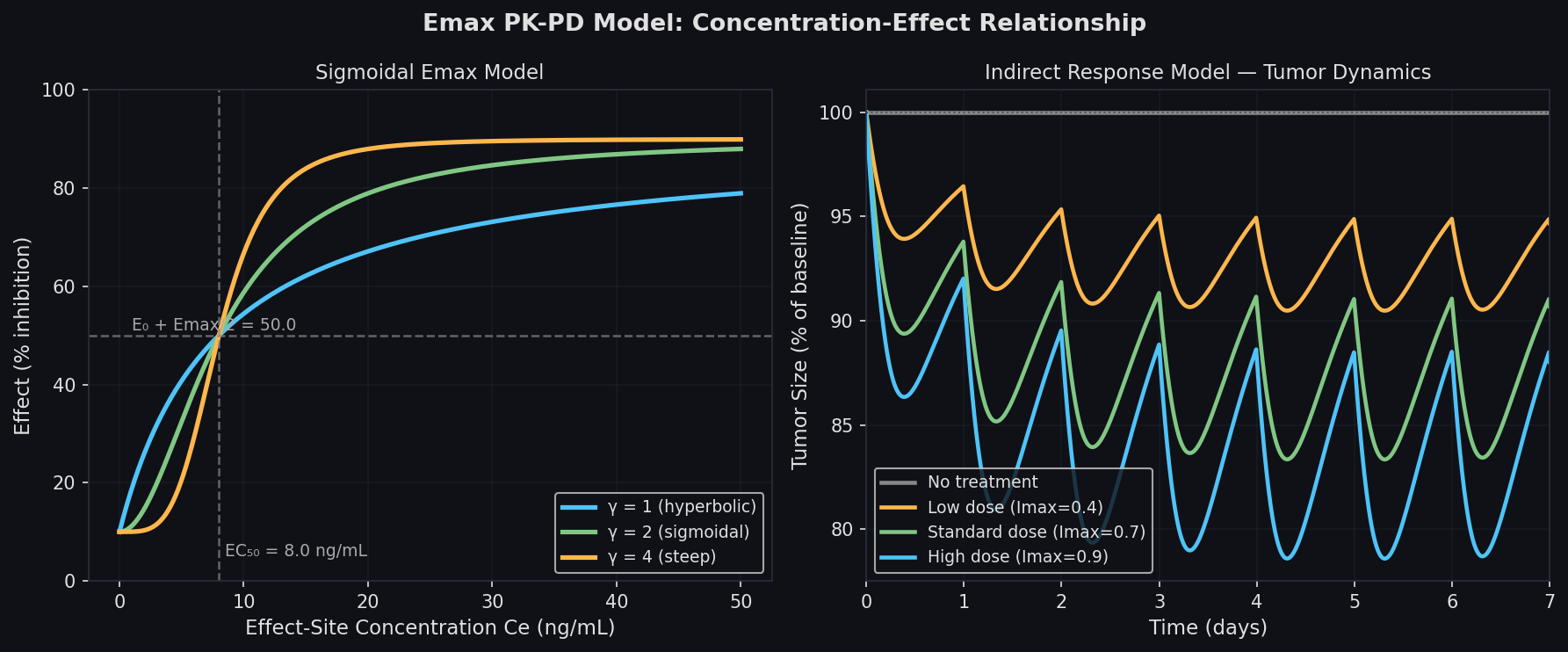
E(t) = E0 + Emax × Ce(t)^γ / (EC50^γ + Ce(t)^γ)where Ce is the effect-site concentration driven by a hypothetical effect compartment with rate constant ke0.
Indirect response models (Dayneka/Jusko) for biomarkers with turnover kinetics (e.g., cortisol suppression, tumor size):
dR/dt = kin × (1 - Imax × C/(IC50 + C)) - kout × RThese models are specified in Monolix using Mlxtran, a domain-specific language that combines ODE definitions with statistical model declarations in a single readable script—far more transparent than NONMEM's cryptic PREDPP subroutines.
Regulatory Acceptance and Industry Adoption
Monolix has received explicit acceptance from the FDA and EMA for population PK analyses submitted in NDAs and MAAs. Key regulatory-facing features include:
- Full audit trail of model runs with timestamped parameter estimates
- R connector (
lixoftConnectorspackage) enabling reproducible, scripted workflows for GxP environments - Monolix Suite integration with PKanalix (NCA), simulx (clinical trial simulation), and Datxplore (data exploration), forming a complete model-informed drug development (MIDD) platform
The FDA's 2019 guidance on population PK explicitly endorses NLME approaches, and Monolix's SAEM-based estimation is cited in multiple published regulatory review documents as producing reliable parameter estimates for sparse pediatric datasets.
Practical Considerations for Practitioners
Shrinkage monitoring: High η-shrinkage (>30%) indicates that individual estimates are pulled toward the population mean, making individual-level diagnostics unreliable. Monolix reports shrinkage automatically—a critical check before interpreting EBE (empirical Bayes estimate) plots.
Handling BQL data: Concentrations below the quantification limit (BQL) require special handling. Monolix implements the M3 method (likelihood-based censoring) natively, avoiding the bias introduced by simple BQL imputation (e.g., BQL = LOQ/2).
Parallelization: SAEM's Monte Carlo step is embarrassingly parallel. Monolix leverages multi-core CPUs automatically, reducing run times for complex TMDD or QSP models from hours to minutes.
Further Resources
- Monolix official documentation
- Lixoft tutorials and case studies
- FDA Population PK Guidance (2022)
- PAGE (Population Approach Group in Europe) proceedings
- Bauer RJ. NONMEM Tutorial Part I: Description of Commands and Options. CPT Pharmacometrics Syst Pharmacol. 2019.
- Lavielle M. Mixed Effects Models for the Population Approach. Chapman & Hall/CRC, 2014.
Simulation Visualizations