
HOMER Pro: Advanced Microgrid Optimization and Techno-Economic Analysis
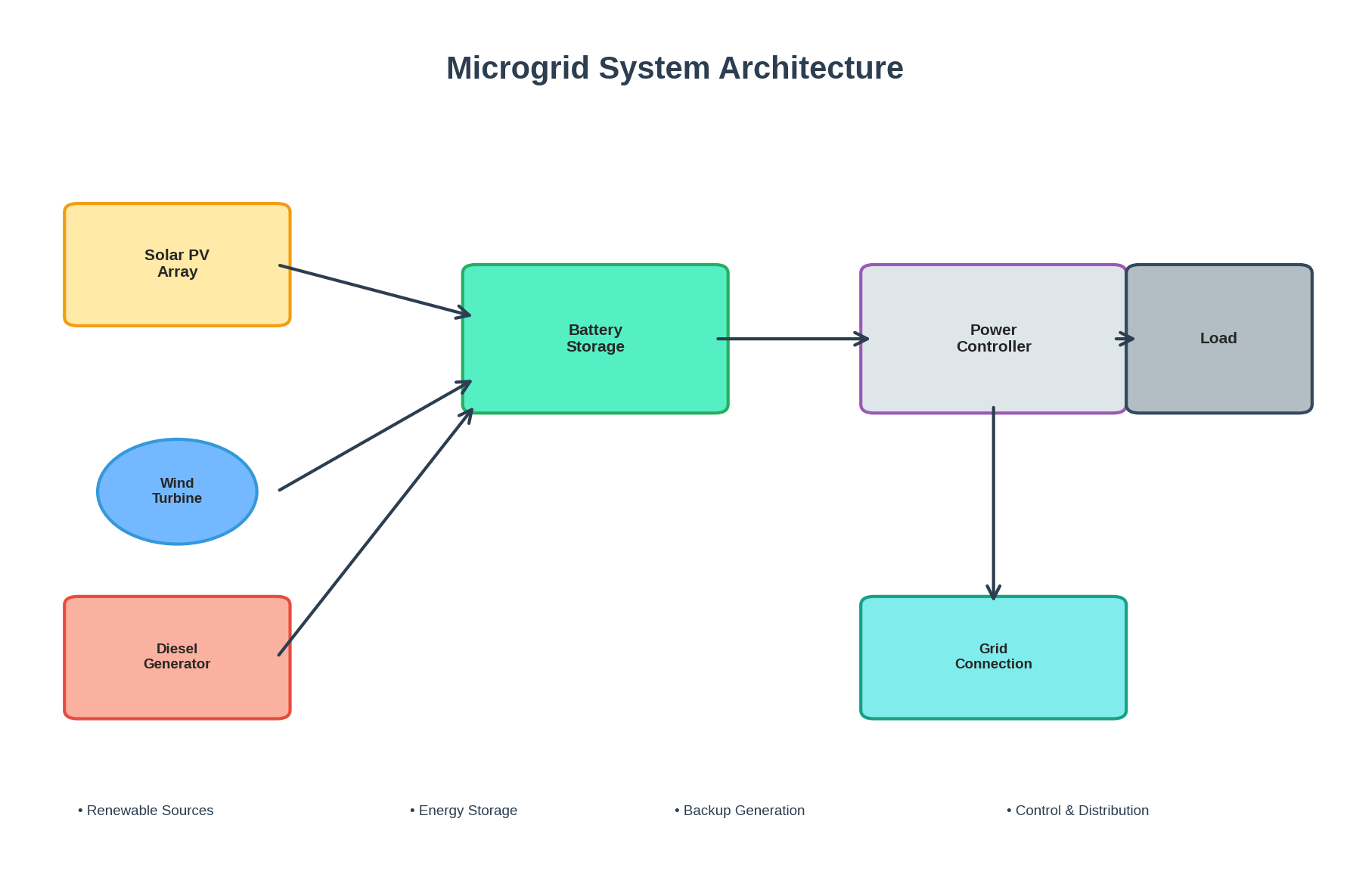
Microgrid design requires balancing technical feasibility with economic viability across thousands of possible system configurations. HOMER Pro (Hybrid Optimization of Multiple Energy Resources) has emerged as the industry-standard tool for microgrid optimization, offering sophisticated algorithms that evaluate system architectures, component sizing, and dispatch strategies to identify optimal solutions for off-grid and grid-connected applications.
Figure 1: Typical microgrid system architecture showing integration of renewable sources, energy storage, backup generation, and control systems.
Multi-Objective Optimization Engine
HOMER Pro's core strength lies in its proprietary optimization engine that performs exhaustive search across user-defined design spaces. Unlike simplified tools that rely on heuristics, HOMER evaluates every feasible combination of system components—solar PV arrays, wind turbines, battery banks, diesel generators, converters, and grid connections—simulating hourly operation over a full year for each configuration.

The optimizer simultaneously minimizes net present cost (NPC) and levelized cost of energy (LCOE) while enforcing technical constraints such as loss-of-load probability, renewable fraction targets, and peak demand requirements. This multi-objective approach produces a Pareto frontier of optimal solutions, allowing engineers to visualize trade-offs between capital expenditure, operating costs, and system reliability.
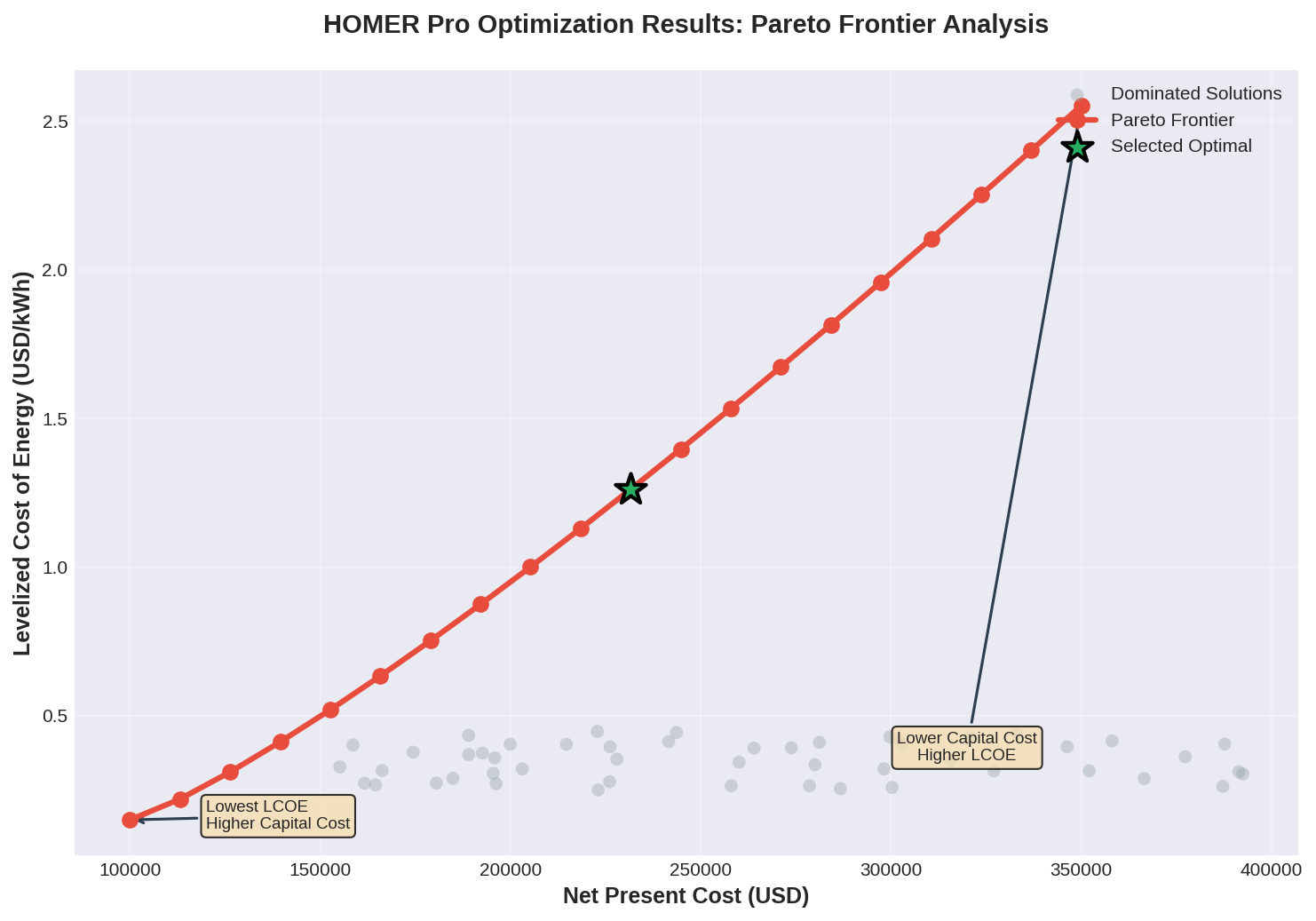
Figure 2: HOMER Pro optimization results showing the Pareto frontier of optimal solutions, balancing net present cost against levelized cost of energy.
For a typical island microgrid project, HOMER might evaluate 50,000+ system architectures in minutes, ranking solutions by economic merit while filtering out technically infeasible designs. The sensitivity analysis module extends this capability by varying input parameters—fuel prices, load growth, equipment costs—to assess project robustness under uncertainty.
Advanced Dispatch Strategy Modeling
HOMER Pro implements sophisticated dispatch logic that determines how energy sources are prioritized each hour to meet load while minimizing operating costs. The load-following and cycle-charging strategies offer different approaches to battery and generator management, with significant implications for fuel consumption and battery lifetime.
The tool's dispatch algorithm accounts for generator minimum load requirements, battery state-of-charge limits, converter efficiency curves, and renewable curtailment when generation exceeds load plus storage capacity. For grid-connected systems, HOMER models net metering, time-of-use rates, and demand charges, optimizing battery dispatch to minimize electricity bills through peak shaving and load shifting.
Recent versions have added predictive dispatch capabilities that use forecasted renewable generation and load profiles to make optimal charging decisions, improving economics by 5-15% compared to rule-based strategies. This feature is particularly valuable for systems with high renewable penetration where anticipatory control prevents unnecessary diesel runtime.
Detailed Component Modeling and Degradation
HOMER Pro includes extensive component libraries with validated performance models for commercial equipment. Solar PV modules are characterized by temperature coefficients, maximum power point tracking efficiency, and soiling losses. Wind turbines use manufacturer power curves with air density corrections and hub height adjustments. Battery models capture voltage-dependent capacity, temperature effects, and cycle-life degradation based on depth-of-discharge and throughput.
The battery lifetime model is especially sophisticated, tracking cumulative damage from cycling and calendar aging to predict replacement timing. HOMER calculates battery throughput, rainflow cycle counting, and temperature-accelerated degradation, providing realistic projections of battery replacement costs over 20-25 year project lifetimes. This level of detail is critical for accurate economic analysis, as battery replacement can represent 30-40% of lifecycle costs in renewable-heavy systems.
Generator modeling includes fuel consumption curves, maintenance schedules based on runtime hours, and efficiency degradation over time. The tool also models converter losses, transformer losses, and distribution system losses, ensuring that parasitic loads are properly accounted in the energy balance.
Integration with Real-World Data and GIS
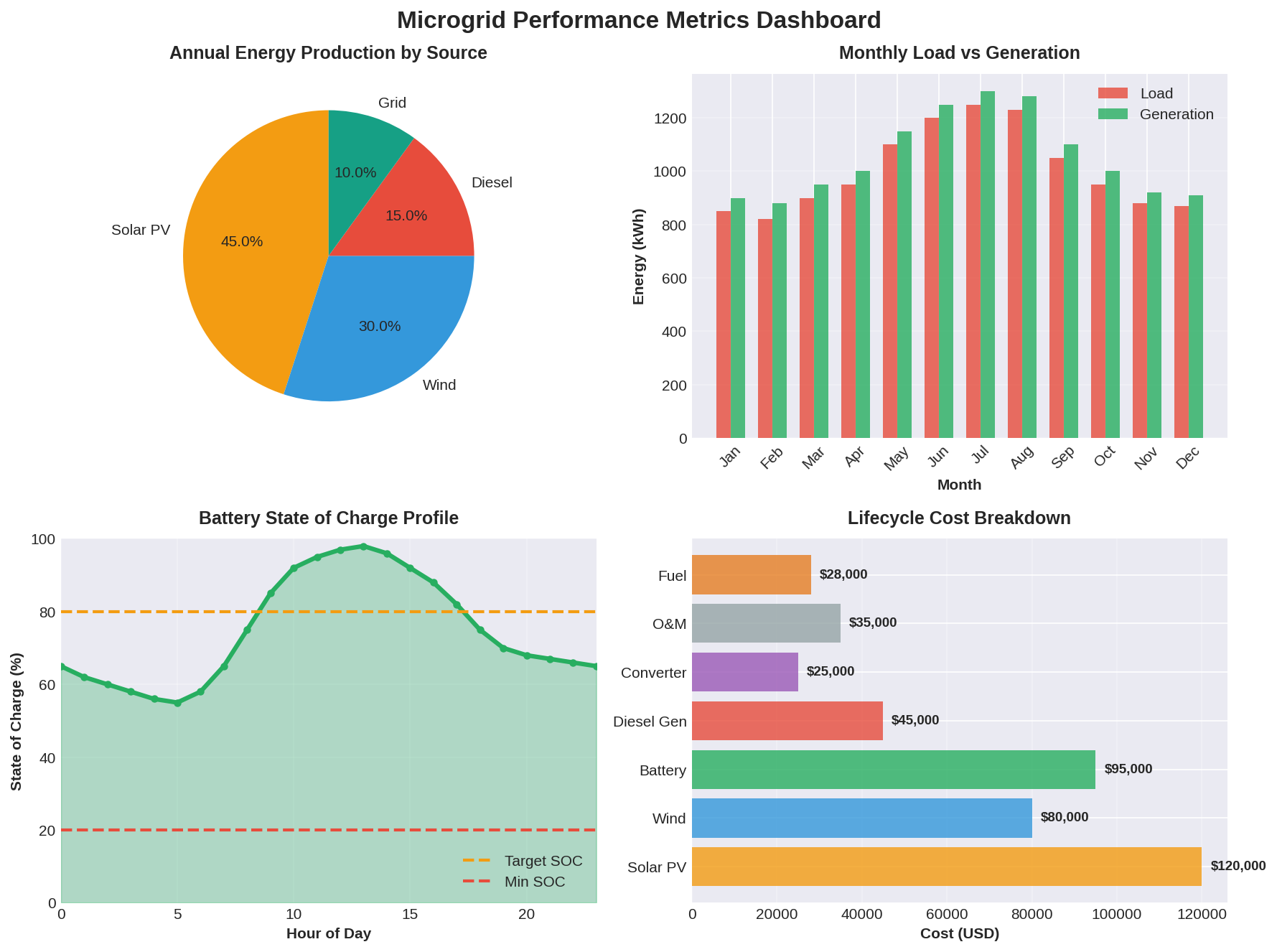
Figure 3: Comprehensive performance metrics dashboard showing energy production mix, load profiles, battery state of charge, and lifecycle cost breakdown.
HOMER Pro integrates with NASA POWER and NREL databases to automatically retrieve solar radiation and wind resource data for any global location. Users can import measured data from on-site monitoring equipment or use synthetic load profiles generated from survey data and appliance inventories.
The HOMER Grid module extends capabilities to utility-scale applications, modeling transmission constraints, ancillary services, and wholesale market participation. For developers working on multiple sites, HOMER's batch processing and API integration enable automated analysis of hundreds of locations, identifying the most promising opportunities for microgrid deployment.
Best Practices for Effective Analysis
Successful HOMER Pro analysis requires careful attention to input data quality and model assumptions. Load profiles should reflect realistic demand patterns including seasonal variations and growth projections. Component costs must include balance-of-system expenses, installation labor, and soft costs like permitting and interconnection.
Sensitivity analysis should span realistic ranges for uncertain parameters—fuel price escalation rates, equipment cost reductions, and load growth scenarios. The optimization search space should be bounded intelligently; allowing excessively large component sizes wastes computation time without yielding practical insights.
For systems with complex tariff structures or multiple load types (AC/DC, thermal, cooling), HOMER's advanced features enable detailed modeling of energy flows and economic interactions. Validation against measured data from existing installations builds confidence in model predictions and helps calibrate assumptions for future projects.
Conclusion
HOMER Pro has become indispensable for microgrid developers, utilities, and researchers worldwide, with over 200,000 users across 193 countries. Its combination of rigorous optimization algorithms, detailed component modeling, and economic analysis capabilities enables confident decision-making for projects ranging from remote village electrification to industrial microgrids and military installations. As renewable energy costs continue declining and battery technology advances, tools like HOMER Pro will remain essential for designing cost-effective, reliable hybrid energy systems.