
pandapower: Python-Native Power System Analysis for Modern Grid Engineers
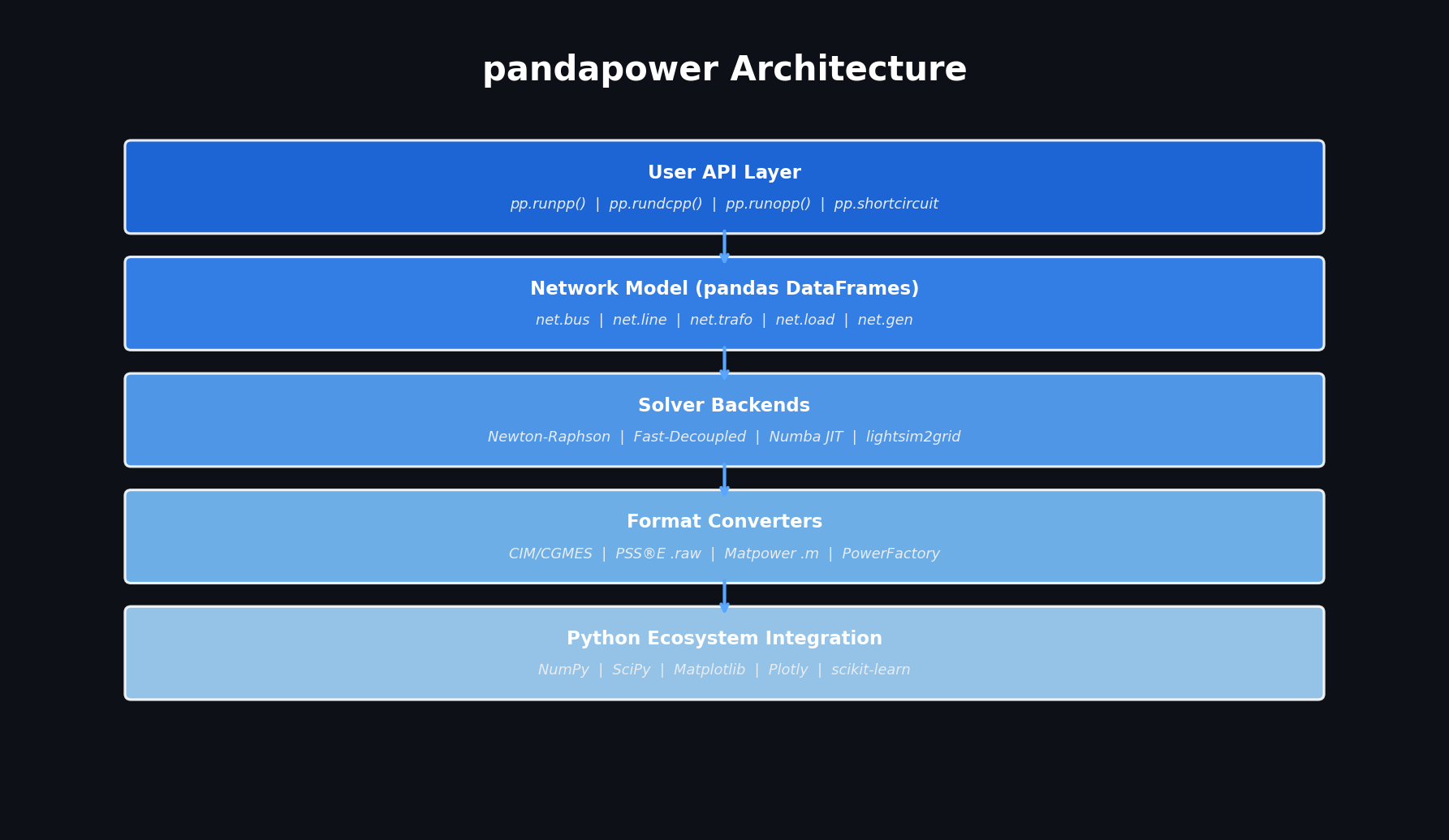
pandapower is an open-source, Python-based power system analysis framework developed jointly by the University of Kassel and Fraunhofer IEE. Unlike legacy tools that rely on proprietary GUIs or MATLAB licenses, pandapower integrates directly into the Python scientific ecosystem — making it a natural fit for engineers who need reproducible, scriptable, and version-controlled power system studies.
What Sets pandapower Apart
At its core, pandapower wraps the well-validated PYPOWER solver (itself a Python port of MATPOWER) and extends it with a rich, object-oriented network model. Networks are stored as pandas DataFrames, which means every bus, line, transformer, load, and generator is a row in a table that can be filtered, merged, and manipulated with standard Python tooling. This design choice has significant practical consequences:
- Reproducibility: Entire case studies can be committed to Git and re-run deterministically.
- Automation: Parametric sweeps, Monte Carlo studies, and sensitivity analyses are straightforward loops — no macro scripting or GUI automation required.
- Integration: Results feed directly into NumPy, SciPy, Matplotlib, and machine-learning pipelines without format conversion.
Core Analysis Capabilities

Power Flow (AC and DC)
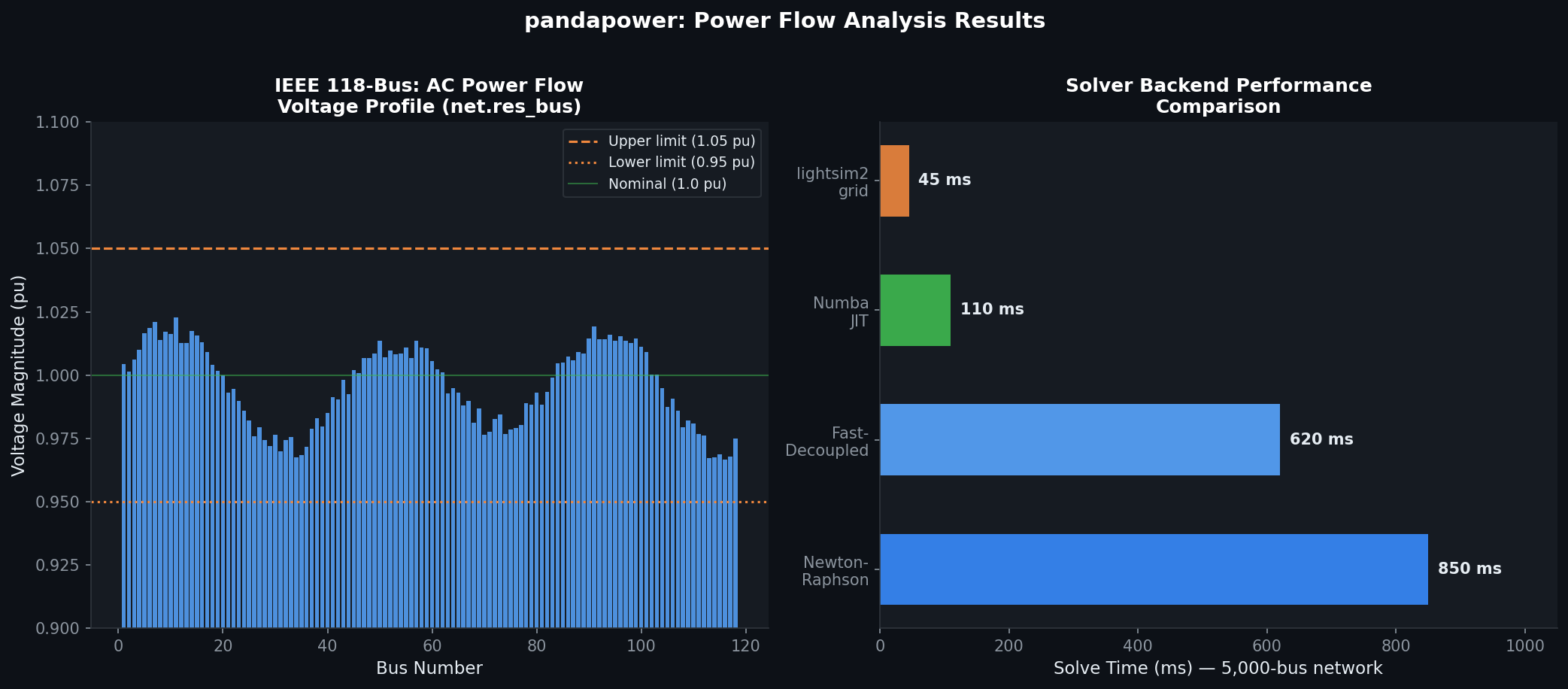
pandapower ships with multiple AC power-flow solvers: Newton-Raphson, Fast-Decoupled (BX and XB variants), Gauss-Seidel, and a Numba-accelerated Newton-Raphson for large networks. The pp.runpp() call is the workhorse for steady-state analysis:
import pandapower as pp
import pandapower.networks as pn

net = pn.case118()          # IEEE 118-bus test case
pp.runpp(net)               # AC power flow
print(net.res_bus.head())   # Bus voltages and angles as a DataFrame
For DC approximations — common in transmission planning and market studies — pp.rundcpp() provides a fast linear alternative.
Optimal Power Flow (OPF)
The built-in OPF engine minimizes a user-defined cost function (typically generation cost) subject to thermal, voltage, and stability constraints. Costs are assigned per generator using polynomial or piecewise-linear functions. The solver leverages PYPOWER's interior-point method and can be extended with custom constraints via the pp.create_poly_cost() API.
Short-Circuit Analysis (IEC 60909 and ANSI)
pandapower implements both IEC 60909 and ANSI/IEEE short-circuit standards, covering three-phase, single-phase-to-ground, two-phase, and two-phase-to-ground fault types. This makes it suitable for protection coordination studies and equipment rating verification:
import pandapower.shortcircuit as sc

sc.calc_sc(net, fault="3ph", case="max")
print(net.res_bus_sc[["ikss_ka", "skss_mw"]])
Contingency Analysis (N-1 Security)
The pandapower.contingency module automates N-1 (and N-k) contingency screening. Engineers define a list of element outages; the module runs power flows for each contingency and flags violations of voltage or thermal limits. This workflow, which would require dozens of manual runs in a GUI tool, reduces to a few lines of Python.
Modeling Depth: Transformers and Asymmetric Networks
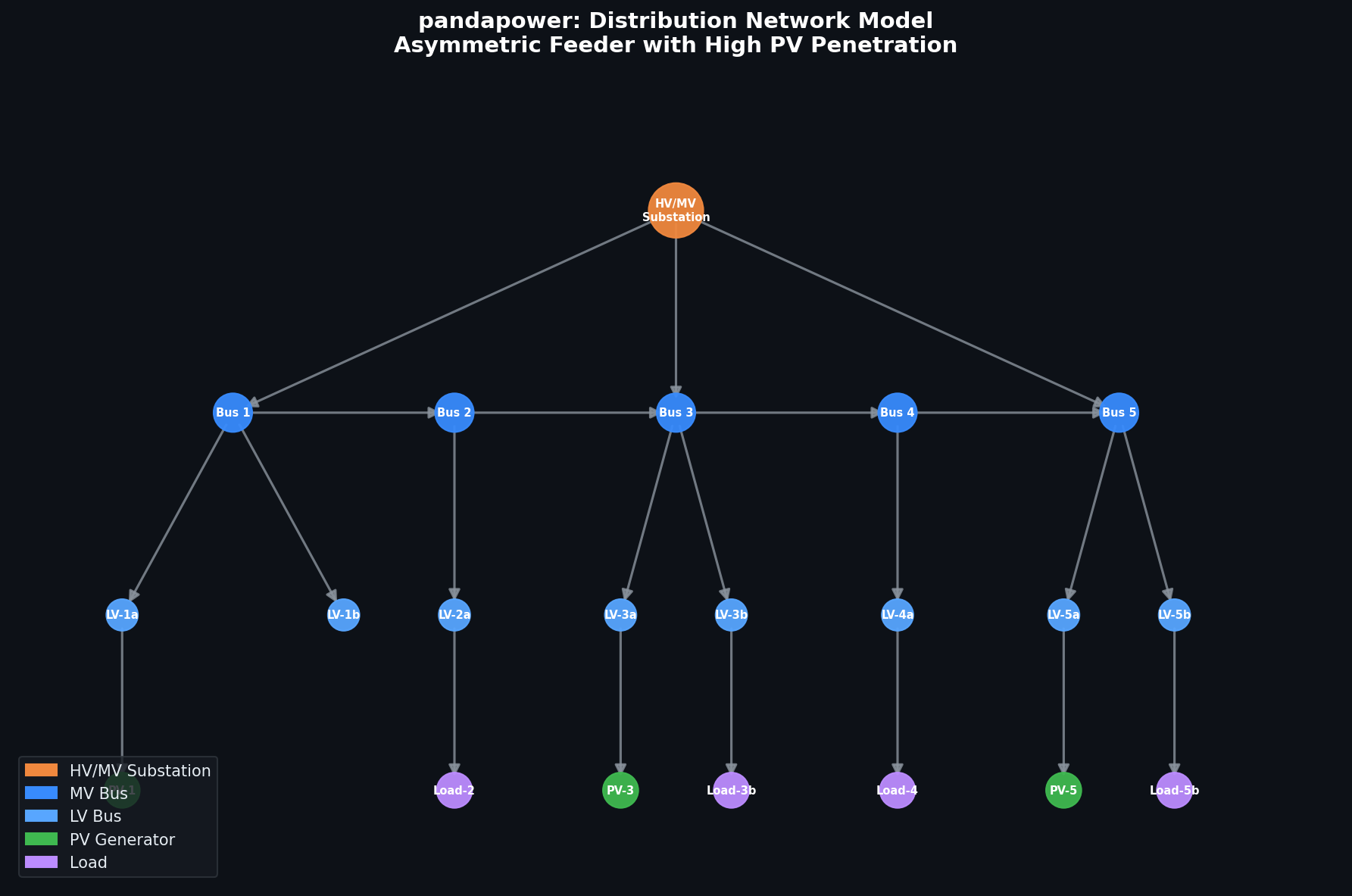
pandapower supports two-winding and three-winding transformers with full tap-changer modeling (on-load tap changers, phase-shifting transformers). For distribution network studies, the asymmetric power flow solver handles unbalanced three-phase networks — critical for low-voltage grids with single-phase loads and rooftop PV.
Integration with pandapipes and Time-Series Analysis
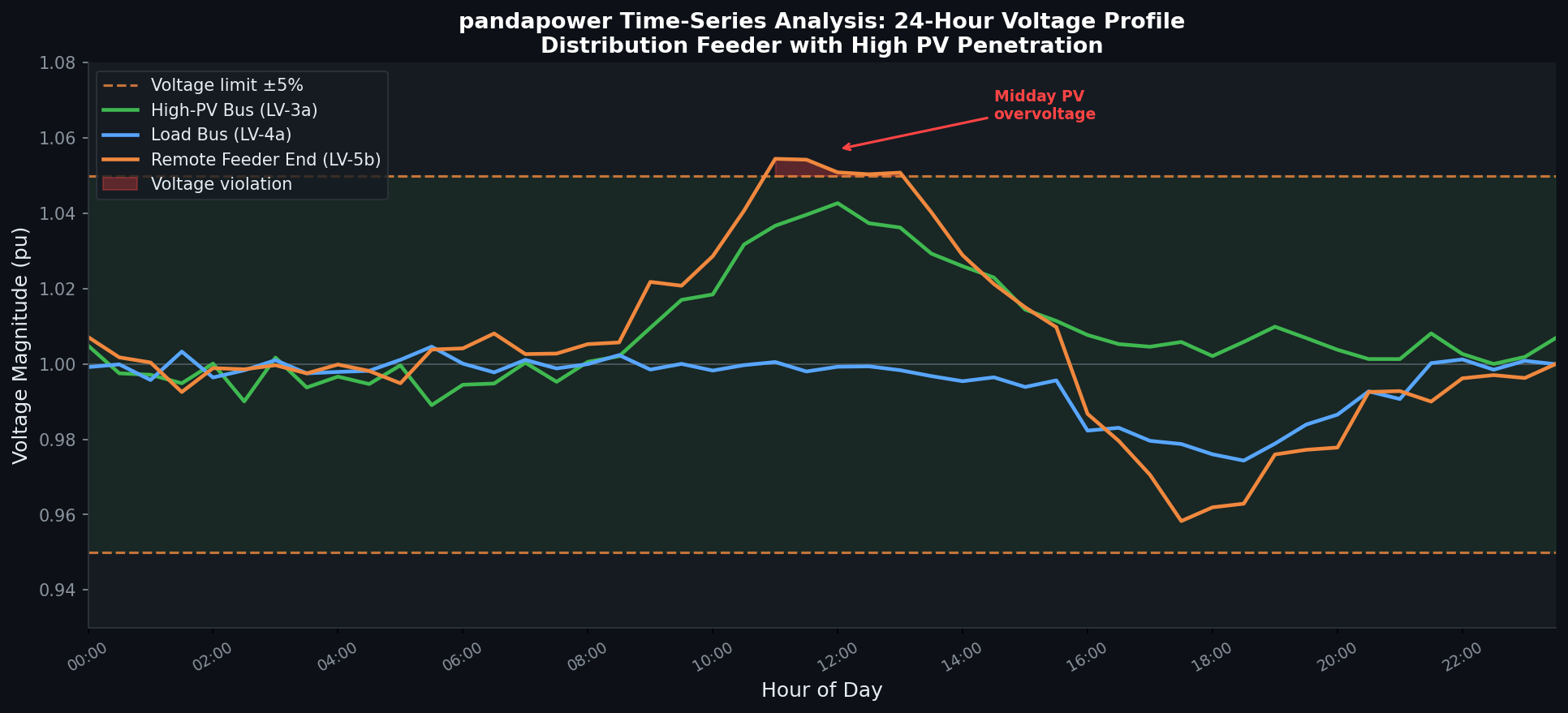
The companion library pandapipes extends the same DataFrame-based paradigm to gas and district-heating networks, enabling coupled power-and-gas simulations. For time-series studies (e.g., 8,760-hour annual simulations with hourly load and generation profiles), the pandapower.timeseries module provides an OutputWriter that efficiently stores selected result columns to disk, avoiding memory overflow on large datasets.
Performance Considerations
For networks with more than ~5,000 buses, enabling Numba JIT compilation (pp.runpp(net, numba=True)) can reduce power-flow solve time by 3–10×. For very large transmission systems, the lightsim2grid backend (a C++ accelerated solver) integrates seamlessly and is the recommended choice for reinforcement-learning grid environments and large-scale Monte Carlo studies.
Practical Workflow: Hosting a Voltage Sensitivity Study
A typical voltage sensitivity study for a distribution feeder with high PV penetration follows this pattern:
- Build or import the network — pandapower reads CIM/CGMES, PSS®E
.raw, and Matpower.mformats via built-in converters. - Attach time-series profiles — load and PV generation profiles as pandas DataFrames.
- Run the time-series loop —
pandapower.timeseries.run_timeseries()iterates over all time steps. - Post-process results — filter
OutputWriterresults for voltage violations, compute statistics, and plot with Matplotlib or Plotly.
Licensing and Community
pandapower is released under the BSD 3-Clause license, making it suitable for both academic research and commercial applications without royalty obligations. The project is actively maintained on GitHub (github.com/e2nIEE/pandapower), with a growing community of contributors from utilities, research institutes, and grid operators worldwide. Comprehensive documentation, including tutorials and a full API reference, is available at pandapower.readthedocs.io.
When to Choose pandapower
pandapower is the right tool when:
- Your workflow is Python-first and you need results as DataFrames, not screenshots.
- You are building automated pipelines — CI/CD for grid models, parametric studies, or ML-based grid control.
- You need open, auditable calculations for regulatory or academic purposes.
- You are working on distribution networks with asymmetric loading or high DER penetration.
For real-time dynamic simulation or detailed electromagnetic transient (EMT) studies, tools such as PSCAD or PSS®E remain more appropriate. But for steady-state analysis, planning studies, and research workflows, pandapower offers a compelling combination of rigor, flexibility, and zero licensing cost.
Further Reading
- pandapower Official Documentation
- pandapower GitHub Repository
- Thurner et al. (2018) — pandapower: An Open-Source Python Tool for Convenient Modeling, Analysis, and Optimization of Electric Power Systems, IEEE Transactions on Power Systems
- pandapipes: Multi-Energy Network Simulation
- MATPOWER — Companion MATLAB/Octave Tool